


Page 89 - Biology_Form_3
P. 89
Biology for Secondary Schools


           metabolism can result into excess water  nitrogenous wastes are removed from the
           and salt in the body. The excess water  bodies of living organisms in a form which
           and salts in the body have to be excreted.  is determined by the availability of water
           Through  excretion,  organisms  remove  in the organism’s environment. In this case
           waste products which are harmful to the  animals living in terrestrial environment
          FOR ONLINE READING ONLY
           cells and organs to maintain homeostasis.  which is characteristically dry usually
           In animals, water is removed through three  excrete urea or uric acid while organisms
           physiological processes namely: urinary  which live in water often excrete ammonia.
           excretion, evaporation from the lungs  Excretion regulates the movement of water
           through breathing and sweating through  and mineral salts inside and outside the cell
           skin. Urinary excretion removes the largest  membranes, therefore, maintaining osmotic
           amount of water. In mammals, nitrogenous  balance. The pH of the body fluid is also
           excretory products are eliminated as urine  regulated by excretion process by removing
           which consists mainly of water, urea and  excess hydrogen ions and acidic metabolic
           salts.                                     wastes. Therefore, without excretion, the
           Excretion facilitates the removal of toxic   equilibrium of these materials shifts and
           wastes from the body which when allowed    disrupts homeostasis and osmotic balance
           to accumulate may damage cells, tissues,   which can lead to serious health problems
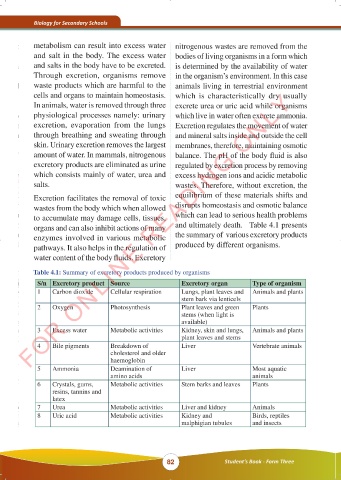
           organs and can also inhibit actions of many   and ultimately death.   Table 4.1 presents
           enzymes involved in various metabolic      the summary of  various excretory products
           pathways. It also helps in the regulation of   produced by different organisms.
           water content of the body fluids. Excretory

           Table 4.1: Summary of excretory products produced by organisms
            S/n Excretory product Source                Excretory organ      Type of organism
            1    Carbon dioxide   Cellular respiration  Lungs, plant leaves and   Animals and plants
                                                        stem bark via lenticels
            2    Oxygen           Photosynthesis        Plant leaves and green   Plants
                                                        stems (when light is
                                                        available)
            3    Excess water     Metabolic activities  Kidney, skin and lungs,   Animals and plants
                                                        plant leaves and stems
            4    Bile pigments    Breakdown of          Liver                Vertebrate animals
                                  cholesterol and older
                                  haemoglobin
            5    Ammonia          Deamination of        Liver                Most aquatic
                                  amino acids                                animals
            6    Crystals, gums,   Metabolic activities  Stem barks and leaves  Plants
                 resins, tannins and
                 latex
            7    Urea             Metabolic activities  Liver and kidney     Animals
            8    Uric acid        Metabolic activities  Kidney and           Birds, reptiles
                                                        malphigian tubules   and insects


                                                    82               Student’s Book - Form Three


                                                                                          23/10/2025   11:52:43
     BIOLOGY FORM 3 FINAL EDITED 16.09.2025.indd   82 KAMISHNA                            23/10/2025   11:52:43                     KAMISHNA
     BIOLOGY FORM 3 FINAL EDITED 16.09.2025.indd   82

