


Page 151 - English_Form_3
P. 151
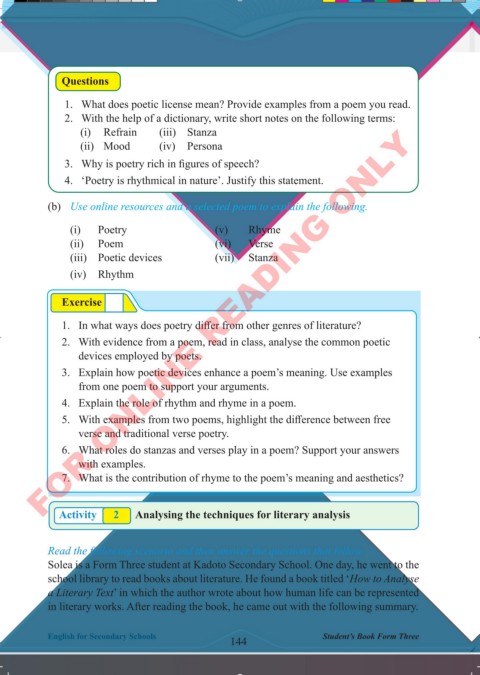
Questions

               1.  What does poetic license mean? Provide examples from a poem you read.
               2.  With the help of a dictionary, write short notes on the following terms:
          FOR ONLINE READING ONLY
                  (i)  Refrain     (iii)    Stanza
                  (ii)  Mood       (iv)    Persona

               3.  Why is poetry rich in figures of speech?
               4.  ‘Poetry is rhythmical in nature’. Justify this statement.


           (b)  Use online resources and a selected poem to explain the following.

                (i)   Poetry                   (v)     Rhyme
                (ii)   Poem                    (vi)    Verse
                (iii)  Poetic devices          (vii)    Stanza
                (iv)  Rhythm


                Exercise

              1.  In what ways does poetry differ from other genres of literature?
              2.  With evidence from a poem, read in class, analyse the common poetic
                  devices employed by poets.
              3.  Explain how poetic devices enhance a poem’s meaning. Use examples
                  from one poem to support your arguments.
              4.  Explain the role of rhythm and rhyme in a poem.
              5.  With examples from two poems, highlight the difference between free
                  verse and traditional verse poetry.
              6.  What roles do stanzas and verses play in a poem? Support your answers
                  with examples.
              7.  What is the contribution of rhyme to the poem’s meaning and aesthetics?


              Activity      2      Analysing the techniques for literary analysis


           Read the following scenario and then answer the questions that follow.
           Solea is a Form Three student at Kadoto Secondary School. One day, he went to the
           school library to read books about literature. He found a book titled ‘How to Analyse
           a Literary Text’ in which the author wrote about how human life can be represented
           in literary works. After reading the book, he came out with the following summary.


           English for Secondary Schools                              Student’s Book Form Three
                                                  144


                                                                                          17/09/2025   16:34:48
     ENGLISH F3 PB.indd   144
     ENGLISH F3 PB.indd   144                                                             17/09/2025   16:34:48

