


Page 89 - Mathematics_Form_3
P. 89
Sequences and series

              Chapter Four


                                                         Sequences and series
          FOR ONLINE READING ONLY


                 Introduction
                In daily life, events and situations often occur in a coordinated manner, where
                one event leads to another. In Mathematics, the occurrence of such patterns
                is referred to as sequences and series. In this chapter, you will learn the
                concepts of sequences and series, identify Arithmetic Progression (AP) and
                Geometric Progression (GP). Also, you will learn how to find the general
                term of an AP and GP, derive formulae for the sum of AP and GP, calculate
                arithmetic mean, geometric mean, and compound interest using formulae.
                The competencies developed will help you in determining compound interests,
                predicting population growth or decay, estimating the age of living and
                non-living things, predicting events which occur at different times, and many
                other applications.


                           Think
                           Mathematics, science, technology, and financial institutions without
                           the concept of sequences and series.

              Sequences                                1.  Use matchsticks to make shapes
      Mathematics for Secondary Schools  by which the terms are obtained the
              When a set of numbers is written in
              a definite order so that there is a rule
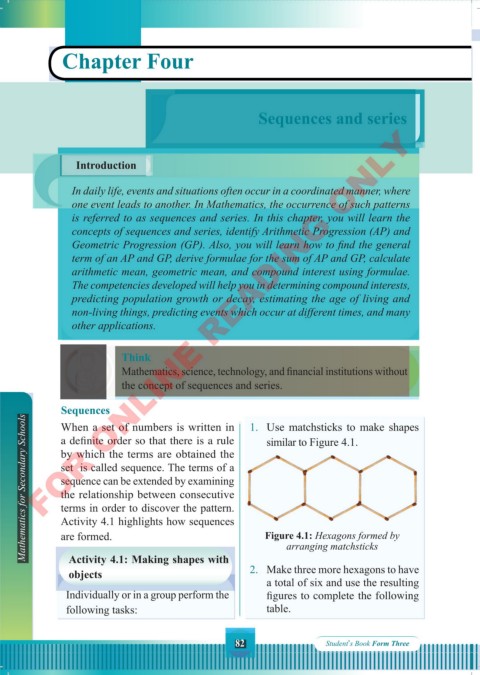
                                                          similar to Figure 4.1.
              set  is called sequence. The terms of a
              sequence can be extended by examining
              the relationship between consecutive
              terms in order to discover the pattern.
              Activity 4.1 highlights how sequences
                                                          Figure 4.1: Hexagons formed by
              are formed.
                                                               arranging matchsticks
                Activity 4.1: Making shapes with
                                                       2.  Make three more hexagons to have
                objects
                                                          a total of six and use the resulting
               Individually or in a group perform the     figures to complete the following
               following tasks:                           table.


                                                    82                 Student\s Book Form Three


                                                                                          18/09/2025   09:59:17
     MATHEMATIC F3 SB.indd   82                                                           18/09/2025   09:59:17
     MATHEMATIC F3 SB.indd   82

