


Page 94 - Mathematics_Form_3
P. 94
Sequences and series


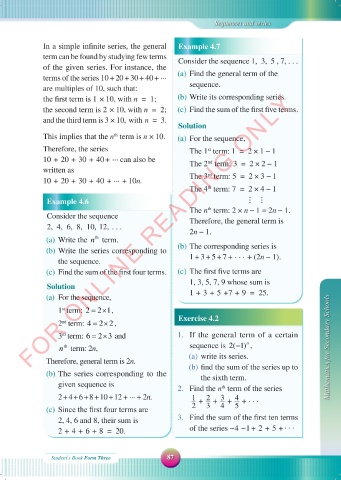
              In a simple infinite series, the general   Example 4.7
              term can be found by studying few terms   Consider the sequence  1,  3,  5 , 7, . . .
              of the given series. For instance, the
                                                       (a) Find the general term of the
              terms of the series  10 + 20 + 30 + 40 +  ···
              are multiples of 10, such that:             sequence.
          FOR ONLINE READING ONLY
              the first term is  1  × 10,  with  n  =  1;   (b) Write its corresponding series.
                the second term is  2  × 10,  with  n  =  2;   (c) Find the sum of the first five terms.
              and the third term is  3 × 10, with n  =  3.
                                                       Solution
                                    th
              This implies that the n  term is  n × 10.   (a) For the sequence,
              Therefore, the series                       The 1  term:  1  =  2 × 1 − 1
                                                                st
              10  +  20  +  30  +  40 +  ···  can also be   The 2  term:  3  =  2 × 2 − 1
                                                                nd
              written as                                        rd
                10  +  20  +  30  +  40  +  ···  + 10n.     The 3  term:  5  =  2 × 3 − 1
                                                                th
                                                          The 4  term:  7  =  2 × 4 − 1
               Example 4.6                                                  ⋮      ⋮
                                                                th
                                                          The n  term:  2 × n − 1 = 2n − 1 .
               Consider the sequence                      Therefore, the general term is
                 2,   4,   6,   8,   10,   12,  . . .
                                                          2n − 1.
                              th
               (a) Write the  n  term.
                                                       (b) The corresponding series is
               (b) Write the series corresponding to
                                                          1 + 3 + 5 + 7 +  · · ·  + (2n − 1).
                   the sequence.
               (c) Find the sum of the first four terms.  (c) The first five terms are
                                                          1, 3, 5, 7, 9 whose sum is
               Solution
               (a)  For the sequence,                     1  +  3  +  5  + 7  +  9  =  25.

                   1  term: 2 = 21× ,
                    st
                   2  term: 4 22= × ,                  Exercise 4.2
                    nd
                   3  term: 6 = 23×  and               1.  If the general term of a certain
                    rd
                    th
                   n  term: 2n,                           sequence is   2( 1)−  n  ,                Mathematics for Secondary Schools
               Therefore, general term is 2n.             (a) write its series.
                                                          (b) find the sum of the series up to
               (b) The series corresponding to the            the sixth term.
                   given sequence is                   2.  Find the n  term of the series
                                                                    th
                                        ...
                     2 + 4 + 6 + 8 + 10 + 12 +   + 2n .                +           +           +           +  · · ·
                                                                    3 __
                                                               2 __
                                                           1 __
                                                                        4 __
               (c) Since the first four terms are          2   3    4   5
                   2, 4, 6 and 8, their sum is         3.  Find the sum of the first ten terms
                   2  +  4  +  6  +  8  =  20.            of the series  − 4  − 1 +  2  +  5  + · · ·


                 Student\s Book Form Three          87


                                                                                          18/09/2025   09:59:19
     MATHEMATIC F3 SB.indd   87                                                           18/09/2025   09:59:19
     MATHEMATIC F3 SB.indd   87

