


Page 96 - Mathematics_Form_3
P. 96
Sequences and series


                                                      since there is a common difference of
                                                      4 between the numbers. An arithmetic
                                                      series is obtained by adding the
                                                      terms of an arithmetic progressions.
                                                      For instance, arithmetic series with
          FOR ONLINE READING ONLY
                                                      common differences 1,  − 2,  and  4x , are
                                                      respectively:
                                                      1.   1   + 2   + 3   + 4   + · · ·  + 99

                                                      2.   − 1  − 3  – 5 − 7−   · · ·
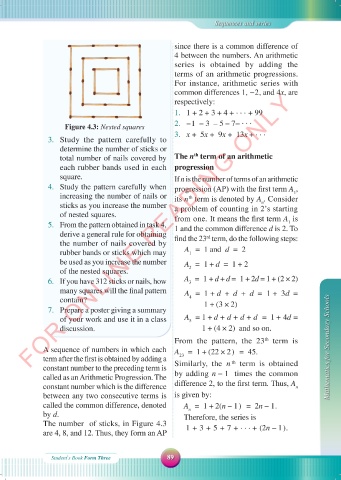
                     Figure 4.3: Nested squares
                                                      3.   x +  5x +  9x +  13x + · · ·
                3.  Study the pattern carefully to
                   determine the number of sticks or
                                                            th
                   total number of nails covered by   The n  term of an arithmetic
                   each rubber bands used in each  progression
                   square.                            If n is the number of terms of an arithmetic
                4.  Study the pattern carefully when   progression (AP) with the first term A ,
                                                                                          1
                   increasing the number of nails or   its   n       term is denoted by   A     . Consider
                                                          th
                                                                                n
                   sticks as you increase the number   a problem of counting in 2’s starting
                   of nested squares.                 from one. It means the first term   A      is
                                                                                        1
                5.  From the pattern obtained in task 4,   1 and the common difference  d  is 2. To
                   derive a general rule for obtaining   find the 23  term, do the following steps:
                                                               rd
                   the number of nails covered by

                   rubber bands or sticks which may        A      =  1 and  d  =  2
                                                          1
                   be used as you increase the number      A      =  1 + d  =  1 + 2
                   of the nested squares.                   2

                6.  If you have 312 sticks or nails, how     A      =  1 + d + d =  1 + 2d = 1 + (2 × 2)
                                                          3
                   many squares will the final pattern     A      =   1 + d +  d +  d =  1 + 3d  =
                   contain?                                 4
                                                               1 + (3 × 2)
                7.  Prepare a poster giving a summary

                   of your work and use it in a class      A      =  1 + d + d + d + d  =  1 + 4d =
                                                          5
                   discussion.                                1 + (4 × 2)       and so on.
                                                                                 th
                                                      From the pattern, the 23  term is
              A sequence of numbers in which each     A       =  1 + (22 × 2 )   =  45.             Mathematics for Secondary Schools
              term after the first is obtained by adding a   Similarly, the    n       term is obtained
                                                       23
                                                                       th
              constant number to the preceding term is
              called as an Arithmetic Progression. The   by adding  n − 1       times the common
              constant number which is the difference   difference 2, to the first term. Thus,   A
                                                                                          n
              between any two consecutive terms is  is given by:
              called the common difference, denoted          A      =  1 + 2(n − 1 )   =  2n − 1.
                                                          n
              by d.                                      Therefore, the series is
              The number  of sticks, in Figure 4.3
              are 4, 8, and 12. Thus, they form an AP      1  +  3  +  5  +  7  +  · · · +  (2n − 1 ).


                 Student\s Book Form Three          89


                                                                                          18/09/2025   09:59:20
     MATHEMATIC F3 SB.indd   89
     MATHEMATIC F3 SB.indd   89                                                           18/09/2025   09:59:20

