


Page 97 - Mathematics_Form_3
P. 97
Sequences and series


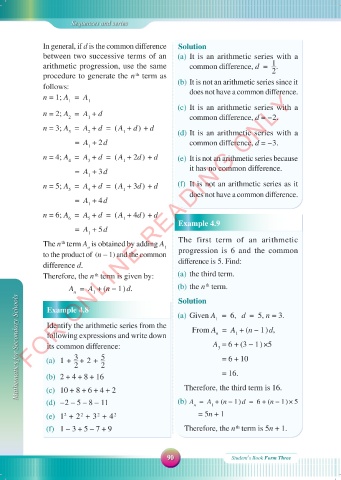
              In general, if  d  is the common difference   Solution
              between two successive terms of an       (a) It is an arithmetic series with a
              arithmetic progression, use the same        common difference,  d  =         .
                                                                                   1 _
              procedure to generate the     n       term as                        2
                                          th
              follows:                                 (b) It is not an arithmetic series since it
          FOR ONLINE READING ONLY
                                                          does not have a common difference.
              n = 1 ;  A      =   A


                      1
                            1
                                                       (c) It is an arithmetic series with a
              n = 2 ;  A      =   A     + d               common difference,  d = − 2.


                            1
                      2
              n = 3 ;  A      =   A     + d  =  (  A     + d )  + d   (d) It is an arithmetic series with a


                                      1
                      3
                            2
                        =  A     + 2 d                    common difference,  d = − 3.
                            1
              n = 4 ;  A      =   A     + d  =  (  A     + 2d )  + d   (e) It is not an arithmetic series because


                                      1
                            3
                      4
                        =  A     + 3 d                    it has no common difference.
                            1
              n = 5 ;  A      =   A     + d  =  (  A     + 3d )  + d   (f)  It is not an arithmetic series as it


                            4
                      5
                                      1
                        =  A     + 4 d                    does not have a common difference.
                            1
              n = 6 ;  A      =   A     + d  =  (  A     + 4d )  + d


                            5
                                      1
                      6
                                                       Example 4.9
                        =  A     + 5 d
                            1
              The   n       term   A      is obtained by adding   A        The first  term  of an arithmetic
                    th
                           n                       1
              to the product of      (  n − 1  )     and the common   progression  is 6 and the common
              difference  d .                          difference is 5. Find:
              Therefore, the   n       term is given by:  (a) the third term.
                              th
                                                               th
                           A      =   A     + (n − 1 ) d.    (b) the   n      term.

                       n     1                         (a) Given   A      =  6,  d  =  5 , n = 3.
      Mathematics for Secondary Schools  ( a )       1  +          +  2  +                                 A       = 6 + (3 − 1 ) ×5
                                                       Solution
               Example 4.8
                                                                  1
               Identify the arithmetic series from the
                                                              From   A      =   A     + (n − 1 ) d ,
                                                                        1
                                                                  n
               following expressions and write down
               its common difference:
                                                                   3
                                                                          = 6 + 10

                       3 __
                                5 __
                       2
                                2
                                                                          = 16 .

               ( b )       2 + 4 + 8 + 16
                                                         Therefore, the third term is 16.
               ( c )       10 + 8 + 6 + 4 + 2
               ( d )       − 2 − 5 − 8 − 11            (b)   A      =   A     + (n − 1 ) d  =  6 + (n − 1 ) × 5
                                                                 1
                                                            n
                                   2
               ( e )       1      +   2      +   3      +   4             = 5n + 1
                              2
                         2
                    2
               (f)    1 − 3 + 5 − 7 + 9                  Therefore, the   n       term is  5n + 1.
                                                                        th
                                                    90                 Student\s Book Form Three
                                                                                          18/09/2025   09:59:21
     MATHEMATIC F3 SB.indd   90                                                           18/09/2025   09:59:21
     MATHEMATIC F3 SB.indd   90

