


Page 90 - Mathematics_Form_3
P. 90
Sequences and series


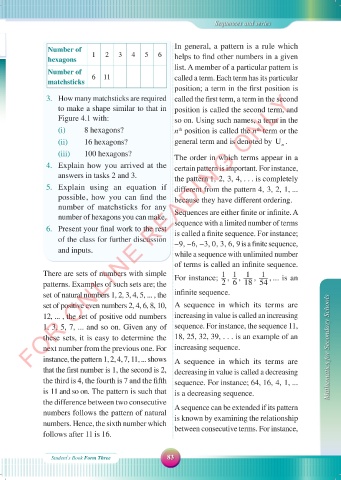
               Number of                              In general, a pattern is a rule which
               hexagons      1   2   3   4   5   6    helps to find other numbers in a given
                                                      list. A member of a particular pattern is
               Number of
               matchsticks   6  11                    called a term. Each term has its particular
                                                      position; a term in the first position is
          FOR ONLINE READING ONLY
               3.  How many matchsticks are required  called the first term, a term in the second
                   to make a shape similar to that in  position is called the second term, and
                   Figure 4.1 with:                   so on. Using such names, a term in the
                                                       th
                   (i)     8 hexagons?                n  position is called the   n       term or the
                                                                               th
                   (ii)    16 hexagons?               general term and is denoted by  U .
                                                                                      n
                   (iii)   100 hexagons?              The order in which terms appear in a
               4.  Explain how you arrived at the     certain pattern is important. For instance,
                   answers in tasks 2 and 3.          the pattern  1,  2,    3,  4,  . . .    is completely

               5.  Explain using an equation if       different from the pattern  4,  3,    2,  1,  ...
                   possible,  how  you  can  find  the   because they have different ordering.
                   number of matchsticks for any      Sequences are either finite or infinite. A
                   number of hexagons you can make.
                                                      sequence with a limited number of terms
               6.  Present your final work to the rest   is called a finite sequence. For instance;
                   of the class for further discussion   − 9, − 6, − 3, 0, 3, 6, 9  is a finite sequence,
                   and inputs.                        while a sequence with unlimited number
                                                      of terms is called an infinite sequence.
              There are sets of numbers with simple   For instance;          ,         ,         ,         ,  ...  is an
                                                                                1
                                                                           1
                                                                    1 __ 1 _ _ _
              patterns. Examples of such sets are; the              2 6 18 54
              set of natural numbers 1, 2, 3, 4, 5, ... , the   infinite sequence.
              set of positive even numbers 2, 4, 6, 8, 10,  A  sequence in which its terms are
              12, ... , the set of positive odd numbers  increasing in value is called an increasing
              1, 3, 5, 7, ... and so on. Given any of  sequence. For instance, the sequence 11,
              these sets, it is easy to determine the  18, 25, 32, 39,  . . .  is an example of an

              next number from the previous one. For   increasing sequence.                         Mathematics for Secondary Schools
              instance, the pattern 1, 2, 4, 7, 11, ... shows   A  sequence in which its terms are
              that the first number is  1 , the second is 2,   decreasing in value is called a decreasing
              the third is 4, the fourth is 7 and the fifth   sequence. For instance;  64, 16, 4, 1,  ...
              is 11 and so on. The pattern is such that   is a decreasing sequence.
              the difference between two consecutive
              numbers follows the pattern of natural   A sequence can be extended if its pattern
                                                      is known by examining the relationship
              numbers. Hence, the sixth number which   between consecutive terms. For instance,
              follows after 11 is 16.


                 Student\s Book Form Three          83


                                                                                          18/09/2025   09:59:18
     MATHEMATIC F3 SB.indd   83
     MATHEMATIC F3 SB.indd   83                                                           18/09/2025   09:59:18

