


Page 115 - Biology Form Two
P. 115
Biology for Secondary Schools


              White blood cells
              These  are irregular shaped cells with
              nuclei as shown  in Figure 5.9.  They
              are also called  leucocytes.  They help    Pathogen
              the body to fight against diseases and     Nucleus
          FOR ONLINE READING ONLY
              infections. One milliliter of blood has
              approximately  5,000 to 10,000 white
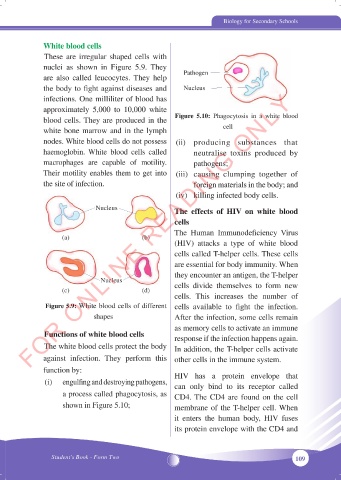
              blood cells. They are produced in the   Figure  5.10:  Phagocytosis  in  a  white  blood
              white bone marrow and in the lymph                     cell
              nodes. White blood cells do not possess  (ii)  producing substances that
              haemoglobin.  White blood cells called        neutralise toxins produced by
              macrophages are capable of motility.          pathogens;
              Their motility enables them to get into  (iii)  causing  clumping together of
              the site of infection.                        foreign materials in the body; and
                                                      (iv)  killing infected body cells.
                              Nucleus                 The effects  of HIV on white blood

                                                      cells
                                                      The  Human  Immunodeficiency  Virus
                    (a)                     (b)
                                                      (HIV)  attacks  a type of white blood
                                                      cells called T-helper cells. These cells
                                                      are essential for body immunity. When
                                                      they encounter an antigen, the T-helper
                               Nucleus                cells  divide  themselves  to form new
                    (c)                     (d)
                                                      cells.  This increases the number of
               Figure 5.9: White blood cells of different  cells  available  to  fight  the  infection.
                             shapes                   After the infection, some cells remain
                                                      as memory cells to activate an immune
              Functions of white blood cells          response if the infection happens again.
              The white blood cells protect the body   In addition, the T-helper cells activate

              against infection.  They perform this   other cells in the immune system.
              function by:                            HIV has a protein envelope  that
               (i)  engulfing and destroying pathogens,   can only bind to its receptor called
                    a process called phagocytosis, as   CD4. The CD4 are found on the cell

                    shown in Figure 5.10;             membrane of the T-helper cell. When
                                                      it enters the human body, HIV fuses
                                                      its protein envelope with the CD4 and


                 Student’s Book - Form Two                                                109


                                                                                          05/10/2024   15:36:39
     BIOLOGY FORM 2 NEW.indd   109                                                        05/10/2024   15:36:39
     BIOLOGY FORM 2 NEW.indd   109

