


Page 114 - Biology Form Two
P. 114
Biology for Secondary Schools


              Plasma is also important for distributing  Another feature is the lack of a nucleus,
              heat to all parts of the body, regulating  which increases the total surface area
              the pH of body fluids, and maintaining  for loading  respiratory  gases.  Their
              a normal balance of body fluids.        membrane is also very flexible and can
                                                      bend in many directions without being
          FOR ONLINE READING ONLY
              Red blood cells                         damaged.  This helps them to  pass
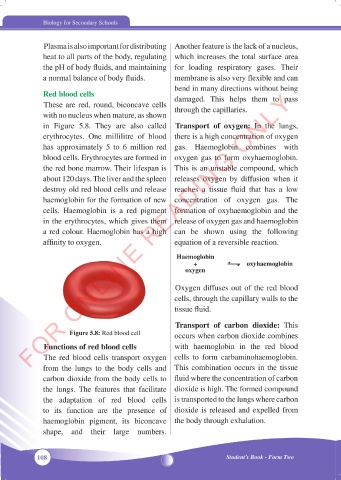
              These are red, round, biconcave cells   through the capillaries.
              with no nucleus when mature, as shown
              in Figure 5.8.  They  are  also called  Transport  of  oxygen: In the  lungs,
              erythrocytes.  One millilitre  of  blood  there is a high concentration of oxygen
              has  approximately  5 to 6 million red  gas. Haemoglobin combines with
              blood cells. Erythrocytes are formed in  oxygen gas to form oxyhaemoglobin.
              the red bone marrow. Their lifespan is  This is an unstable compound, which
              about 120 days. The liver and the spleen  releases  oxygen by  diffusion when it
              destroy old red blood cells and release  reaches  a  tissue  fluid  that  has  a  low
              haemoglobin for the formation of new  concentration  of  oxygen  gas. The
              cells. Haemoglobin is a red pigment  formation of oxyhaemoglobin and the
              in the erythrocytes, which gives them  release of oxygen gas and haemoglobin
              a red colour. Haemoglobin has a high  can  be  shown  using the following
              affinity to oxygen.                     equation of a reversible reaction.

                                                      Haemoglobin
                                                            +                oxyhaemoglobin
                                                         oxygen

                                                      Oxygen diffuses out of the red blood
                                                      cells, through the capillary walls to the
                                                      tissue fluid.

                                                      Transport of  carbon dioxide: This
                      Figure 5.8: Red blood cell      occurs when carbon dioxide combines
              Functions of red blood cells            with  haemoglobin in the red blood
              The  red blood cells  transport  oxygen  cells to form carbaminohaemoglobin.
              from the  lungs to the body cells and  This combination occurs in the tissue
              carbon dioxide from the body cells to  fluid where the concentration of carbon
              the  lungs.  The features that facilitate  dioxide is high. The formed compound
              the adaptation of red blood cells  is transported to the lungs where carbon
              to  its  function  are  the  presence  of  dioxide is released and expelled from
              haemoglobin  pigment,  its  biconcave  the body through exhalation.
              shape, and their large numbers.


            108                                                      Student’s Book - Form Two


                                                                                          05/10/2024   15:36:39
     BIOLOGY FORM 2 NEW.indd   108
     BIOLOGY FORM 2 NEW.indd   108                                                        05/10/2024   15:36:39

