


Page 109 - Biology Form Two
P. 109
Biology for Secondary Schools


               Table 5.1:   Adaptation of the heart to its functions
                 Adaptive feature                          Function
               Muscular walls         Contract to pump blood

               Cardiac muscles        Contract and relax continuously without getting fatigued to
          FOR ONLINE READING ONLY
                                      ensure continuous pumping of the blood
               Valves                 Ensure blood flows in one direction
               Septum                 Separates the left and right sides of the heart to prevent
                                      mixing of oxygenated and deoxygenated blood

               Sinoatrial node        Sets time and rate of contraction of cardiac muscles
               Coronary artery and    The coronary artery nourishes the heart and supplies it with
               coronary vein          oxygen. The coronary vein removes waste that would harm
                                      the heart if left to accumulate
               Connection with        Enables the heart to pump out deoxygenated blood to the
               pulmonary artery and   lungs and receives oxygenated blood from the lungs
               pulmonary vein
               Pericardial fluid      Prevents friction as the heart beats

               Connection with vena   Enables the heart to receive deoxygenated blood and pumps
               cava and aorta         out oxygenated blood

              Blood vessels                           Arteries
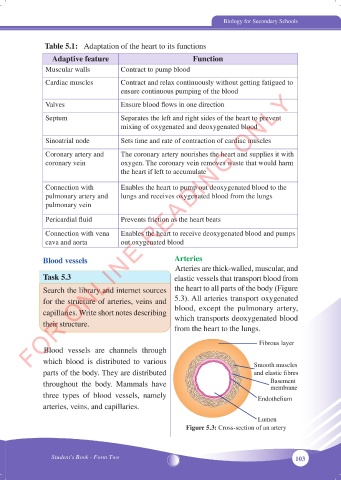
                                                      Arteries are thick-walled, muscular, and
              Task 5.3                                elastic vessels that transport blood from

              Search the library and internet sources   the heart to all parts of the body (Figure
              for the structure of arteries, veins and   5.3). All arteries transport oxygenated
              capillaries. Write short notes describing   blood, except the pulmonary artery,
              their structure.                        which transports deoxygenated blood
                                                      from the heart to the lungs.

                                                                               Fibrous layer
              Blood vessels are channels through
              which blood is  distributed  to various                         Smooth muscles
              parts of the body. They are distributed                         and elastic fibres

              throughout the body. Mammals have                                    Basement
                                                                                   membrane
              three types of  blood  vessels,  namely                          Endothelium
              arteries, veins, and capillaries.
                                                                               Lumen
                                                         Figure 5.3: Cross-section of an artery


                 Student’s Book - Form Two                                                103


                                                                                          05/10/2024   15:36:38
     BIOLOGY FORM 2 NEW.indd   103                                                        05/10/2024   15:36:38
     BIOLOGY FORM 2 NEW.indd   103

