


Page 105 - Biology Form Two
P. 105
Biology for Secondary Schools


              expanding when it is beating very fast.  gets fatigued; they work continuously
              The pericardium also protects the heart  as long as a person is alive. This type
              from  mechanical  injury  and  friction.  of muscle is found only in the  heart.
              It provides enough room for vigorous  The inner layer is called endocardium.
              pumping of the heart. In addition, the
          FOR ONLINE READING ONLY
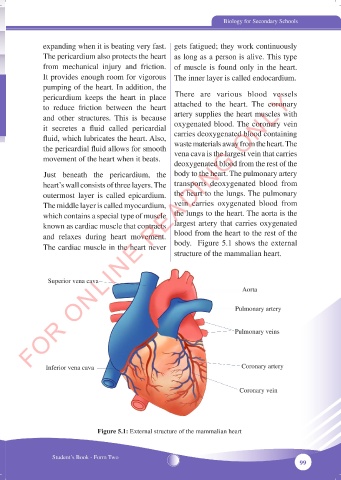
              pericardium  keeps  the  heart  in  place   There are various  blood vessels
              to reduce friction  between the  heart   attached to the  heart. The  coronary
              and other structures.  This is because   artery supplies the heart muscles with
              it  secretes  a  fluid  called  pericardial   oxygenated blood. The coronary vein
              fluid, which lubricates the heart. Also,   carries deoxygenated blood containing
              the pericardial fluid allows for smooth   waste materials away from the heart. The
                                                      vena cava is the largest vein that carries
              movement of the heart when it beats.
                                                      deoxygenated blood from the rest of the
              Just beneath the  pericardium,  the     body to the heart. The pulmonary artery
              heart’s wall consists of three layers. The   transports deoxygenated  blood from
              outermost layer is called  epicardium.   the heart to the lungs. The pulmonary
              The middle layer is called myocardium,   vein carries oxygenated  blood from
              which contains a special type of muscle   the lungs to the heart. The aorta is the
              known as cardiac muscle that contracts   largest artery that carries oxygenated
              and relaxes during  heart  movement.    blood from the heart to the rest of the
              The cardiac muscle in the heart never   body.  Figure 5.1 shows the external
                                                      structure of the mammalian heart.


                Superior vena cava
                                                                          Aorta


                                                                        Pulmonary artery


                                                                        Pulmonary veins


               Inferior vena cava                                         Coronary artery


                                                                         Coronary vein


                               Figure 5.1: External structure of the mammalian heart


                 Student’s Book - Form Two
                                                                                            99


                                                                                          05/10/2024   15:36:37
     BIOLOGY FORM 2 NEW.indd   99
     BIOLOGY FORM 2 NEW.indd   99                                                         05/10/2024   15:36:37

