


Page 106 - Biology Form Two
P. 106
Biology for Secondary Schools


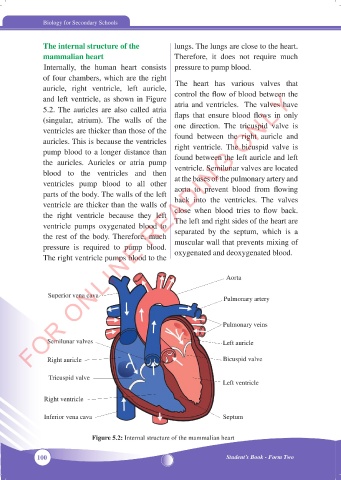
              The internal structure of the           lungs. The lungs are close to the heart.
              mammalian heart                         Therefore, it does not require much
              Internally, the  human  heart  consists  pressure to pump blood.
              of four chambers, which are the right
              auricle, right ventricle,  left auricle,   The  heart has various  valves that
          FOR ONLINE READING ONLY
              and left ventricle, as shown in Figure   control the flow of blood between the
              5.2. The  auricles  are  also  called  atria   atria and ventricles.  The valves have
              (singular, atrium).  The  walls  of  the   flaps  that  ensure  blood  flows  in  only
              ventricles are thicker than those of the   one direction.  The tricuspid valve is
              auricles. This is because the ventricles   found between the  right  auricle  and
              pump blood to a longer distance than    right  ventricle.  The  bicuspid  valve  is
              the  auricles.  Auricles or atria pump   found between the left auricle and left
              blood  to  the  ventricles and  then    ventricle. Semilunar valves are located
              ventricles  pump  blood  to all  other   at the bases of the pulmonary artery and
              parts of the body. The walls of the left   aorta to prevent  blood  from  flowing
              ventricle are thicker than the walls of   back into  the  ventricles.  The valves
              the right ventricle  because they left   close  when  blood  tries  to  flow  back.
              ventricle  pumps oxygenated  blood to   The left and right sides of the heart are
              the rest of the body. Therefore, much   separated  by the  septum,  which is a
              pressure is required  to pump blood.    muscular wall that prevents mixing of
              The right ventricle pumps blood to the   oxygenated and deoxygenated blood.


                                                                     Aorta

                Superior vena cava                                   Pulmonary artery


                                                                    Pulmonary veins


               Semilunar valves                                     Left auricle

               Right auricle                                        Bicuspid valve

                Tricuspid valve
                                                                    Left ventricle

              Right ventricle


              Inferior vena cava                                    Septum


                             Figure 5.2: Internal structure of the mammalian heart


            100                                                      Student’s Book - Form Two


                                                                                          05/10/2024   15:36:37
     BIOLOGY FORM 2 NEW.indd   100                                                        05/10/2024   15:36:37
     BIOLOGY FORM 2 NEW.indd   100

