


Page 111 - Biology Form Two
P. 111
Biology for Secondary Schools


              Veins
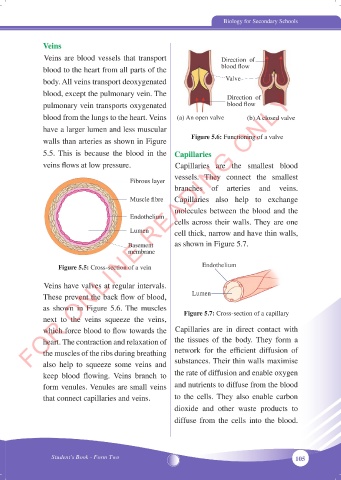
              Veins are blood vessels that transport                Direction  of
              blood to the heart from all parts of the              blood flow
              body. All veins transport deoxygenated                 Valve
          FOR ONLINE READING ONLY
              blood, except the pulmonary vein. The                   Direction  of
              pulmonary vein transports oxygenated                    blood flow
              blood from the lungs to the heart. Veins   (a) An open valve  (b) A closed valve
              have a larger lumen and less muscular

              walls than arteries as shown in Figure       Figure 5.6: Functioning of a valve
              5.5.  This  is because  the  blood  in  the   Capillaries
              veins flows at low pressure.            Capillaries  are  the  smallest  blood
                                                      vessels. They  connect  the  smallest
                                        Fibrous layer
                                                      branches of  arteries and  veins.

                                        Muscle fibre  Capillaries  also help to exchange
                                                      molecules between the blood and the
                                        Endothelium
                                                      cells across their walls. They are one
                                        Lumen         cell thick, narrow and have thin walls,

                                        Basement      as shown in Figure 5.7.
                                        membrane

                   Figure 5.5: Cross-section of a vein        Endothelium

              Veins have valves at regular intervals.
              These prevent the back flow of blood,        Lumen
              as shown in Figure 5.6. The muscles        Figure 5.7: Cross-section of a capillary
              next to the  veins squeeze the  veins,

              which force blood to flow towards the   Capillaries  are  in  direct  contact  with
              heart. The contraction and relaxation of   the  tissues of the body.  They form a
              the muscles of the ribs during breathing   network  for  the  efficient  diffusion of
              also help to squeeze some  veins and    substances. Their thin walls maximise
              keep  blood  flowing.  Veins  branch  to   the rate of diffusion and enable oxygen
              form venules. Venules are small veins   and nutrients to diffuse from the blood
              that connect capillaries and veins.     to  the cells. They also enable  carbon
                                                      dioxide and other waste products to
                                                      diffuse from the  cells  into  the  blood.


                 Student’s Book - Form Two                                                105


                                                                                          05/10/2024   15:36:38
     BIOLOGY FORM 2 NEW.indd   105                                                        05/10/2024   15:36:38
     BIOLOGY FORM 2 NEW.indd   105

