


Page 116 - Biology Form Two
P. 116
Biology for Secondary Schools


              then enters the cell. Once inside the cell, the virus becomes part of the T-helper
              cell and replicates together with it as it undergoes division. This increases the
              number of HIV in the blood. The HIV destroys T-helper cells resulting in the
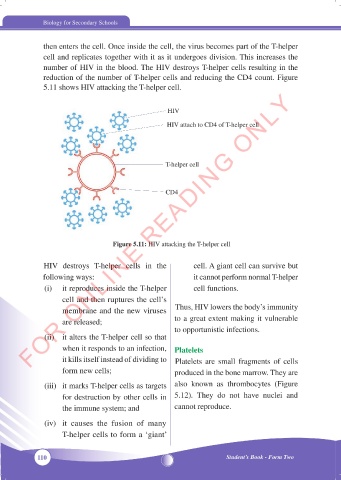
              reduction of the number of T-helper cells and reducing the CD4 count. Figure
              5.11 shows HIV attacking the T-helper cell.
          FOR ONLINE READING ONLY

                                                    HIV

                                                    HIV attach to CD4 of T-helper cell


                                                   T-helper cell


                                                   CD4


                                   Figure 5.11: HIV attacking the T-helper cell


              HIV  destroys  T-helper  cells  in  the       cell. A giant cell can survive but
              following ways:                               it cannot perform normal T-helper
              (i)   it reproduces inside the T-helper       cell functions.

                    cell and then ruptures the cell’s
                    membrane and the new viruses      Thus, HIV lowers the body’s immunity
                    are released;                     to a great extent making it vulnerable
                                                      to opportunistic infections.
              (ii)  it alters the T-helper cell so that
                    when it responds to an infection,   Platelets
                    it kills itself instead of dividing to   Platelets  are small  fragments of cells
                    form new cells;                   produced in the bone marrow. They are

              (iii)  it marks T-helper cells as targets   also known  as thrombocytes (Figure
                    for destruction by other cells in   5.12).  They do not  have nuclei and
                    the immune system; and            cannot reproduce.

              (iv)  it  causes  the  fusion  of  many
                    T-helper cells to form a ‘giant’


            110                                                      Student’s Book - Form Two


                                                                                          05/10/2024   15:36:39
     BIOLOGY FORM 2 NEW.indd   110                                                        05/10/2024   15:36:39
     BIOLOGY FORM 2 NEW.indd   110

