


Page 9 - Biology Form Two
P. 9
Biology for Secondary Schools


              used for various activities. Digestion,   which one  species  benefits,  while  the

              which takes place by the release of     other is neither harmed nor benefitted.
              enzymes outside the cell, is also called   In most  cases,  the  host individual  is
              extracellular digestion. An example of   larger than the commensal individual.
              a saprophyte is a mushroom growing on   Commensal  organisms  benefit  in
          FOR ONLINE READING ONLY
              a log. The mushroom releases enzymes    various ways such as in getting
              externally through their root-like
              structures, called rhizoids. The enzymes   nutrients, shelter, support, or transport
              cause decomposition and decay of the    from the  host. For example, small

              log from which the mushroom gets        fishes like remora attach to the body of
              its  nutrients. Another example of a    a large fish such as a shark. The shark
              saprophyte is bread mould that grows on   enables remora to move in different
              the surface of decaying bread to obtain   areas without using its own energy, but

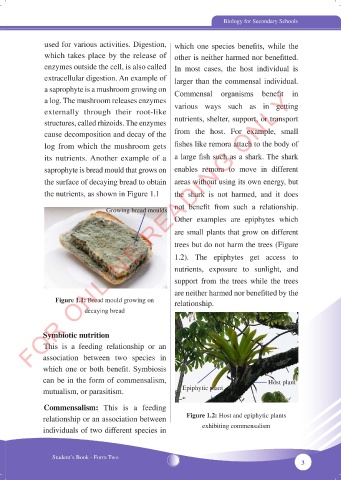
              the nutrients, as shown in Figure 1.1    the shark is not harmed, and it does
                                                      not  benefit  from  such  a  relationship.
                                 Growing bread moulds
                                                      Other examples are  epiphytes which

                                                      are small plants that grow on different
                                                      trees but do not harm the trees (Figure

                                                      1.2). The  epiphytes get access to
                                                      nutrients, exposure to sunlight, and
                                                      support from the trees while the trees
                                                      are neither harmed nor benefitted by the
                  Figure 1.1: Bread mould growing on   relationship.
                           decaying bread


              Symbiotic nutrition
              This  is  a  feeding  relationship  or an
              association between two  species in

              which one or both benefit. Symbiosis
              can be in the form of commensalism,                                 Host plant
              mutualism, or parasitism.                 Epiphytic plant

              Commensalism:  This is a  feeding
              relationship or an association between     Figure 1.2: Host and epiphytic plants
              individuals of two different species in         exhibiting commensalism


                 Student’s Book - Form Two
                                                                                            3


                                                                                          05/10/2024   15:36:18
     BIOLOGY FORM 2 NEW.indd   3
     BIOLOGY FORM 2 NEW.indd   3                                                          05/10/2024   15:36:18

