


Page 14 - Biology Form Two
P. 14
Biology for Secondary Schools


              molecules found in certain  foods and  in the liver. The glycogen is stored
              drinks. Sources  of carbohydrates include  in the liver and muscles, while fats
              maize, sweet potatoes, sugarcane,  are stored as fat deposits in the lower
              bananas, cassava, fruits, and yams, as  abdomen, around kidneys, and under
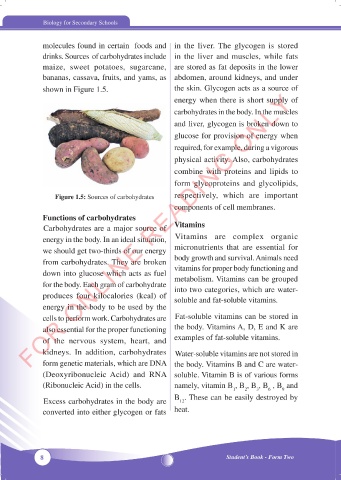
              shown in Figure 1.5.                    the skin. Glycogen acts as a source of
          FOR ONLINE READING ONLY
                                                      energy when there is short supply of
                                                      carbohydrates in the body. In the muscles
                                                      and liver, glycogen is broken down to

                                                      glucose for provision of energy when
                                                      required, for example, during a vigorous
                                                      physical activity. Also, carbohydrates
                                                      combine with proteins and lipids to

                                                      form glycoproteins and glycolipids,
                  Figure 1.5: Sources of carbohydrates  respectively, which are important
                                                      components of cell membranes.
              Functions of carbohydrates
              Carbohydrates are a major source of     Vitamins
              energy in the body. In an ideal situation,   Vitamins are complex organic
              we should get two-thirds of our energy   micronutrients that are  essential for
              from carbohydrates. They are broken     body growth and survival. Animals need

              down into glucose which acts as fuel    vitamins for proper body functioning and
                                                      metabolism. Vitamins can be grouped
              for the body. Each gram of carbohydrate   into two categories, which are water-
              produces four kilocalories (kcal) of    soluble and fat-soluble vitamins.
              energy in the body to be used by the
              cells to perform work. Carbohydrates are   Fat-soluble vitamins can be stored in
              also essential for the proper functioning   the body. Vitamins A, D, E and K are
              of the nervous system,  heart, and      examples of fat-soluble vitamins.

              kidneys. In addition,  carbohydrates    Water-soluble vitamins are not stored in
              form genetic materials, which are DNA  the body. Vitamins B and C are water-
              (Deoxyribonucleic Acid) and RNA  soluble. Vitamin B is of various forms
              (Ribonucleic Acid) in the cells.        namely, vitamin B , B , B , B  , B  and
                                                                       1   2   3  6   9
              Excess carbohydrates in the body are    B . These can be easily destroyed by
                                                       12
              converted into either glycogen or fats   heat.


             8                                                       Student’s Book - Form Two


                                                                                          05/10/2024   15:36:18
     BIOLOGY FORM 2 NEW.indd   8
     BIOLOGY FORM 2 NEW.indd   8                                                          05/10/2024   15:36:18

