


Page 17 - Biology Form Two
P. 17
Biology for Secondary Schools


              Minerals                                  Function of minerals
              Minerals are inorganic elements that      Most  minerals are important for
              come from the soil and water and are      enzyme  activities.  Some minerals
              absorbed and used by living organisms.    are essential for maintaining balance
              In animal  nutrition,  minerals fulfill   of body fluids, development of
          FOR ONLINE READING ONLY
              multiple functions in the physiology of   bone tissue, synthesis of hormones,
              all systems. Different types of minerals   activation of enzymes, transmission of
              are needed for different activities in the   nerve impulses, as  well as contraction
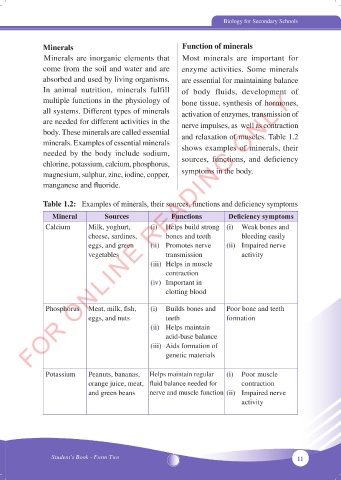
              body. These minerals are called essential   and relaxation of muscles. Table 1.2
              minerals. Examples of essential minerals   shows examples of minerals, their
              needed by the body include sodium,        sources, functions, and deficiency
              chlorine, potassium, calcium, phosphorus,
              magnesium, sulphur, zinc, iodine, copper,   symptoms in the body.
              manganese and fluoride.


              Table 1.2:  Examples of minerals, their sources, functions and deficiency symptoms
                 Mineral         Sources             Functions        Deficiency symptoms
               Calcium      Milk, yoghurt,     (i)  Helps build strong  (i)  Weak bones and
                            cheese, sardines,      bones and teeth        bleeding easily
                            eggs, and green    (ii)  Promotes nerve   (ii)  Impaired nerve
                            vegetables             transmission           activity
                                               (iii)  Helps in muscle
                                                   contraction
                                               (iv)  Important in
                                                   clotting blood

               Phosphorus   Meat, milk, fish,   (i)  Builds bones and   Poor bone and teeth
                            eggs, and nuts         teeth              formation
                                               (ii)  Helps maintain
                                                   acid-base balance
                                               (iii)  Aids formation of
                                                   genetic materials


               Potassium    Peanuts, bananas,   Helps maintain regular   (i)  Poor muscle
                            orange juice, meat,  fluid balance needed for   contraction
                            and green beans   nerve and muscle function (ii)  Impaired nerve
                                                                          activity


                 Student’s Book - Form Two                                                 11


                                                                                          05/10/2024   15:36:18
     BIOLOGY FORM 2 NEW.indd   11
     BIOLOGY FORM 2 NEW.indd   11                                                         05/10/2024   15:36:18

