


Page 13 - Biology Form Two
P. 13
Biology for Secondary Schools


              When proteins are consumed, they are
              broken down into amino acids that are
              absorbed into the bloodstream and used
              by the body to produce its own proteins.
              For example, the  haemoglobin found
          FOR ONLINE READING ONLY
              in the red  blood cells is one of the
              body  proteins.  Haemoglobin  enables
              red blood cells to transport oxygen in

              our bodies.  Other  examples  of body          Figure 1.4: Sources of lipids
              proteins include  antibodies  which
              provide body  immunity  and  enzymes    Functions of lipids
              that are involved in food digestion. In   Lipids are a source of energy. They
              addition, many  hormones are protein    provide more energy than all other food
              in  nature.  They  control  and  regulate   substances. Each gram of lipid provides
              various processes in the body.          nine kilocalories (kcal) of energy.
                                                      They are important components of cell
              Lipids                                  membranes. Fat deposits surround and
              They are organic compounds made of  protect body organs such as the heart
              carbon, hydrogen, and oxygen. They are  and kidneys. Stores of fat in the adipose
              insoluble in water but soluble in organic  tissue under the skin help to regulate
              solvents such as ether and benzene. The  body temperature by insulating the
              main forms of dietary lipids are fats and  body against loss of heat. Fat-soluble
              oils. Fats are solid at room temperature  vitamins are also stored in fatty tissues.
              while oils are liquid at room temperature.  Essential fatty acids are important for
              Lipids are made up of fatty acids and  the formation of substances that help to
              glycerol. Fatty acids can be essential or  control blood pressure and activate the
              non-essential. Essential fatty acids are  body’s immune response.
              obtained from foods eaten while non-
              essential fatty acids can be made by the   Carbohydrates
              body. The body can not produce essential
              fatty acids. It is, therefore, important   Carbohydrates are organic compounds
              to eat foods that contain essential fatty   made up of small repeating units called
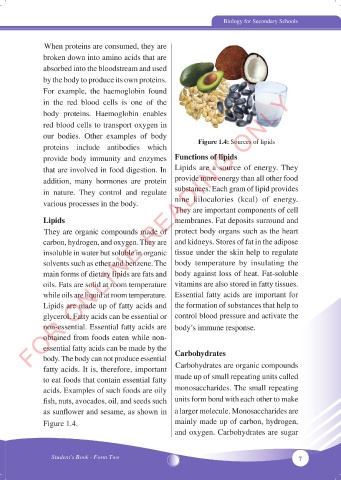
              acids. Examples of such foods are oily   monosaccharides. The small repeating
              fish, nuts, avocados, oil, and seeds such   units form bond with each other to make
              as sunflower and sesame, as shown in  a larger molecule. Monosaccharides are
              Figure 1.4.                             mainly made up of carbon, hydrogen,
                                                      and oxygen. Carbohydrates are sugar


                 Student’s Book - Form Two                                                 7


                                                                                          05/10/2024   15:36:18
     BIOLOGY FORM 2 NEW.indd   7                                                          05/10/2024   15:36:18
     BIOLOGY FORM 2 NEW.indd   7

