


Page 15 - Biology Form Two
P. 15
Biology for Secondary Schools


              Vitamins  are formed by the  combination
              of glucose and some mineral elements.
              Most of the  vitamins  are  synthesised
              by autotrophs, particulary green plants.
          FOR ONLINE READING ONLY
              Mammals  can synthesise  vitamins  A
              and D using plant molecules obtained
              in  their  food. Examples  of foods
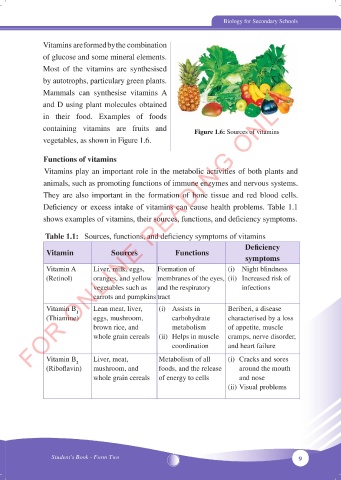
              containing  vitamins are fruits and           Figure 1.6: Sources of vitamins

              vegetables, as shown in Figure 1.6.

              Functions of vitamins
              Vitamins play an important role in the metabolic activities of both plants and

              animals, such as promoting functions of immune enzymes and nervous systems.
              They are also important  in the formation  of bone tissue and red  blood cells.
              Deficiency or excess intake of vitamins can cause health problems. Table 1.1
              shows examples of vitamins, their sources, functions, and deficiency symptoms.


               Table 1.1:   Sources, functions, and deficiency symptoms of vitamins
                                                                           Deficiency
               Vitamin             Sources            Functions
                                                                           symptoms
               Vitamin A     Liver, milk, eggs,   Formation of        (i)  Night blindness
               (Retinol)     oranges, and yellow  membranes of the eyes,  (ii)  Increased risk of
                             vegetables such as   and the respiratory     infections
                             carrots and pumpkins tract
               Vitamin B     Lean meat, liver,   (i)  Assists in      Beriberi, a disease
                        1
               (Thiamine)    eggs, mushroom,         carbohydrate     characterised by a loss
                             brown rice, and         metabolism       of appetite, muscle
                             whole grain cereals  (ii)  Helps in muscle   cramps, nerve disorder,
                                                     coordination     and heart failure

               Vitamin B     Liver, meat,        Metabolism of all    (i)  Cracks and sores
                        2
               (Riboflavin)   mushroom, and      foods, and the release   around the mouth
                             whole grain cereals  of energy to cells     and nose
                                                                      (ii) Visual problems


                 Student’s Book - Form Two                                                 9


                                                                                          05/10/2024   15:36:18
     BIOLOGY FORM 2 NEW.indd   9
     BIOLOGY FORM 2 NEW.indd   9                                                          05/10/2024   15:36:18

