


Page 30 - Chemistry_Form_2
P. 30
Chemistry
                                                                           for Secondary Schools


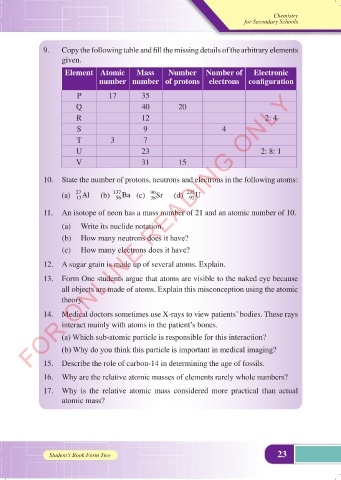
              9.    Copy the following table and fill the missing details of the arbitrary elements
                    given.

                     Element Atomic       Mass      Number  Number of         Electronic
                               number number of protons         electrons   configuration
          FOR ONLINE READING ONLY
                        P         17        35
                        Q                   40         20
                        R                   12                                   2: 4
                        S                   9                       4
                        T         3         7

                        U                   23                                  2: 8: 1
                        V                   31         15

              10.  State the number of protons, neutrons and electrons in the following atoms:

                                              90
                    (a)    27 Al     (b)   137 Ba   (c)   Sr    (d)   235 U
                                                          92
                        13
                                               38
                                    56
              11.  An isotope of neon has a mass number of 21 and an atomic number of 10.
                    (a)   Write its nuclide notation.
                    (b)  How many neutrons does it have?
                    (c)   How many electrons does it have?

              12.  A sugar grain is made up of several atoms. Explain.

              13.  Form One students argue that atoms are visible to the naked eye because
                    all objects are made of atoms. Explain this misconception using the atomic
                    theory.
              14.  Medical doctors sometimes use X-rays to view patients’ bodies. These rays
                    interact mainly with atoms in the patient’s bones.

                    (a) Which sub-atomic particle is responsible for this interaction?
                    (b) Why do you think this particle is important in medical imaging?

              15.  Describe the role of carbon-14 in determining the age of fossils.
              16.  Why are the relative atomic masses of elements rarely whole numbers?

              17.  Why  is  the  relative  atomic  mass  considered  more  practical  than  actual
                    atomic mass?


                Student’s Book Form Two                                              23


                                                                                          01/08/2025   11:20:52
     CHEMISTRY FORM TWO NEW 2025 DUMMY.indd   23                                          01/08/2025   11:20:52
     CHEMISTRY FORM TWO NEW 2025 DUMMY.indd   23

