


Page 33 - Chemistry_Form_2
P. 33
Chemistry
              for Secondary Schools


              Law, which was based on atomic masses, the modern periodic table is structured
              according to atomic numbers. Therefore, it led to the development of the modern
              Periodic Law which states that the properties of elements are a periodic function
              of their atomic numbers. This means that elements exhibit recurring (periodic)
              chemical properties when arranged in increasing atomic number, a phenomenon
          FOR ONLINE READING ONLY
              known as periodicity. For example,  lithium,  a very reactive  metal,  has one
              electron in its outermost shell. The eighth element after lithium is sodium, which
              shares many of the same characteristics as lithium, including a single electron in
              its outermost shell and high reactivity. Similarly, the eighth element after sodium
              is potassium, which also exhibits the same properties. This periodic recurrence of
              chemical behaviour is among the fundamental principles of the modern periodic
              table.
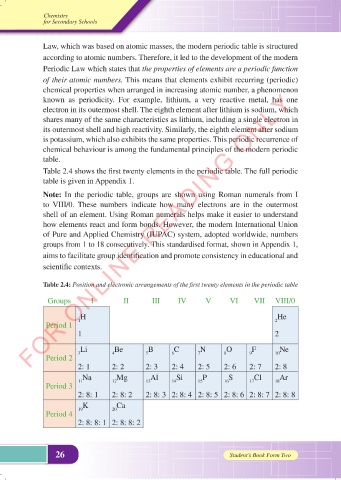
              Table 2.4 shows the first twenty elements in the periodic table. The full periodic
              table is given in Appendix 1.

              Note: In the periodic table, groups are shown using Roman numerals from I
              to  VIII/0.  These numbers indicate  how many electrons are in the outermost
              shell of an element. Using Roman numerals helps make it easier to understand
              how elements react and form bonds. However, the modern International Union
              of Pure and Applied Chemistry (IUPAC) system, adopted worldwide, numbers
              groups from 1 to 18 consecutively. This standardised format, shown in Appendix 1,
              aims to facilitate group identification and promote consistency in educational and
              scientific contexts.


              Table 2.4:  Position and electronic arrangements of the first twenty elements in the periodic table

               Groups        I        II       III     IV      V       VI     VII   VIII/0

                         H                                                           He
               Period 1  1                                                          2
                         1                                                          2

                         Li         Be        B       C       N      O       F        Ne
                         3         4         5       6       7       8      9       10
               Period 2
                         2: 1      2: 2      2: 3    2: 4    2: 5    2: 6   2: 7    2: 8
                          Na        Mg        Al      Si      P       S       Cl      Ar
                         11        12        13      14      15      16     17      18
               Period 3
                         2: 8: 1   2: 8: 2   2: 8: 3 2: 8: 4 2: 8: 5 2: 8: 6 2: 8: 7 2: 8: 8
                          K         Ca
               Period 4  19        20
                         2: 8: 8: 1 2: 8: 8: 2


                  26                                                  Student’s Book Form Two


                                                                                          01/08/2025   11:20:52
     CHEMISTRY FORM TWO NEW 2025 DUMMY.indd   26
     CHEMISTRY FORM TWO NEW 2025 DUMMY.indd   26                                          01/08/2025   11:20:52

