


Page 36 - Chemistry_Form_2
P. 36
Chemistry
                                                                           for Secondary Schools


              Elements are also arranged into periods, which indicate the number of electron
              shells in an atom. Table 2.4 shows that elements with the same number of shells
              belong to the same period. Periods are numbered from 1 to 7. The electronic
              configuration entails the number of shells for each element. Periods and number
              of shells of the first twenty elements are shown in Table 2.5.
          FOR ONLINE READING ONLY
              Table 2.5: Periods and number of shells of the first twenty elements

               Period      Elements                                     Number of shells
               Period 1    Hydrogen and helium                                  1
                           Lithium, beryllium, boron, carbon, nitrogen,
               Period 2                                                         2
                           oxygen, fluorine and neon

                           Sodium, magnesium, aluminium, silicon,
               Period 3                                                         3
                           phosphorus, sulfur, chlorine and argon
               Period 4    Potassium and calcium                                4


              Electronic  configurations  help  to  explain  the  positioning  of  elements  in  the

              periodic table. Elements in the same group share the same number of valence
              electrons, while elements in the same period have the same number of electron
              shells. This arrangement forms the basis for predicting chemical behaviour and
              classifying elements efficiently.


              Exercise 2.2

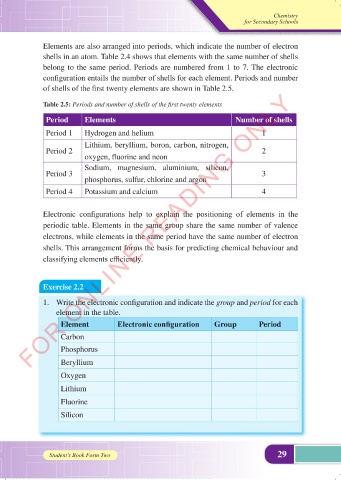
              1.  Write the electronic configuration and indicate the group and period for each
                  element in the table.
                   Element           Electronic configuration     Group        Period
                   Carbon

                   Phosphorus
                   Beryllium

                   Oxygen
                   Lithium

                   Fluorine
                   Silicon


                Student’s Book Form Two                                              29


                                                                                          01/08/2025   11:20:53
     CHEMISTRY FORM TWO NEW 2025 DUMMY.indd   29                                          01/08/2025   11:20:53
     CHEMISTRY FORM TWO NEW 2025 DUMMY.indd   29

