


Page 32 - Chemistry_Form_2
P. 32
Chemistry
                                                                           for Secondary Schools


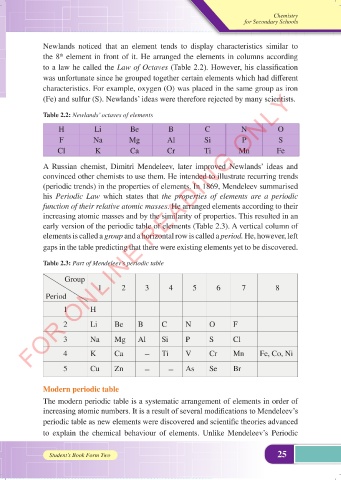
              Newlands noticed that an  element tends to display characteristics  similar to
              the 8  element in front of it. He arranged the elements in columns according
                   th
              to a law he called the Law of Octaves (Table 2.2). However, his classification
              was unfortunate since he grouped together certain elements which had different
              characteristics. For example, oxygen (O) was placed in the same group as iron
          FOR ONLINE READING ONLY
              (Fe) and sulfur (S). Newlands’ ideas were therefore rejected by many scientists.

              Table 2.2: Newlands’ octaves of elements
                   H          Li        Be          B          C          N          O
                   F         Na         Mg          Al         Si         P          S
                  Cl          K         Ca          Cr         Ti        Mn          Fe

              A Russian chemist,  Dimitri  Mendeleev, later  improved  Newlands’ ideas  and
              convinced other chemists to use them. He intended to illustrate recurring trends
              (periodic trends) in the properties of elements. In 1869, Mendeleev summarised
              his  Periodic  Law  which  states  that  the  properties  of  elements  are  a periodic
              function of their relative atomic masses. He arranged elements according to their
              increasing atomic masses and by the similarity of properties. This resulted in an
              early version of the periodic table of elements (Table 2.3). A vertical column of
              elements is called a group and a horizontal row is called a period. He, however, left
              gaps in the table predicting that there were existing elements yet to be discovered.

              Table 2.3: Part of Mendeleev’s periodic table

                     Group
                               1      2      3      4      5       6      7         8
               Period
                    1       H

                    2       Li      Be     B      C      N      O       F

                    3       Na      Mg     Al     Si     P      S       Cl

                    4       K       Ca        ̶   Ti     V      Cr      Mn      Fe, Co, Ni

                    5       Cu      Zn        ̶      ̶   As     Se      Br

              Modern periodic table

              The modern periodic table is a systematic arrangement of elements in order of
              increasing atomic numbers. It is a result of several modifications to Mendeleev’s
              periodic table as new elements were discovered and scientific theories advanced
              to explain the chemical  behaviour of elements. Unlike Mendeleev’s  Periodic


                Student’s Book Form Two                                              25


                                                                                          01/08/2025   11:20:52
     CHEMISTRY FORM TWO NEW 2025 DUMMY.indd   25                                          01/08/2025   11:20:52
     CHEMISTRY FORM TWO NEW 2025 DUMMY.indd   25

