


Page 31 - Chemistry_Form_2
P. 31
Chemistry
              for Secondary Schools

             Chapter


                 Two                        Periodic classification


          FOR ONLINE READING ONLY

              Introduction

              Many elements have been discovered. Therefore, studying each element individually
              is challenging. The elements are better understood and managed when they are
              classified. The most effective way to classify them is by using a table known as  the
              periodic table. In this chapter, you will learn about the development of the periodic

              table, electronic configuration and element positioning in the periodic table, and
              changes in physical and chemical properties across periods and down the groups.
              The competencies developed will provide a foundation for studying elements and
              predicting how chemicals behave and their applications in everyday life.


                             Think


                             Periodic classification is the backbone of chemistry applications.


              Development of the periodic table

                  Task 2.1

              Utilise online or any reliable resources to search the dynamic changes that led to
              the development of the modern periodic table.


              For a long time, chemists have used various ways of grouping elements with
              similar properties. The simplest of these has been classifying elements as either
              metals or non-metals. In 1866, a British chemist, John Newlands, thought of the
              idea of arranging elements in order of their increasing atomic masses. Newlands
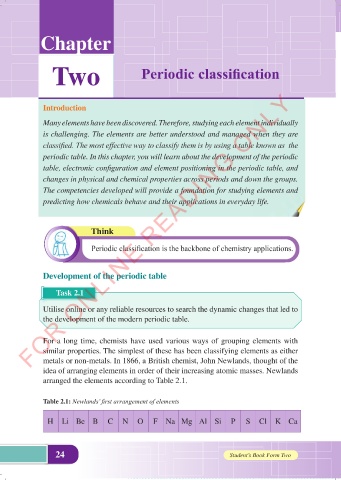
              arranged the elements according to Table 2.1.


              Table 2.1: Newlands’ first arrangement of elements

               H    Li Be    B    C   N    O   F   Na Mg Al Si         P   S   Cl   K Ca


                  24                                                  Student’s Book Form Two


                                                                                          01/08/2025   11:20:52
     CHEMISTRY FORM TWO NEW 2025 DUMMY.indd   24                                          01/08/2025   11:20:52
     CHEMISTRY FORM TWO NEW 2025 DUMMY.indd   24

