


Page 115 - Mathematics_Form_Two
P. 115
Exponents and radicals


           16.  A rectangular plot of land has an area of  5000  square metres. If the length of the
                plot is      metres, what is the width of the plot?

           17.  A box has a volume of  54000  cubic centimetres. If the height of the box is
                  300  centimetres, what is the area of the base?
             FOR ONLINE READING ONLY
           18.  The height of a tree is  320  metres. Another tree has a height of  180  metres.
                What is the ratio of the heights of the two trees?

           19.  A cylindrical tank  has a volume of  288 cubic metres. If the height of the tank
                is  18 metres, what is the area of the base of the cylinder?                         Mathematics for Secondary Schools


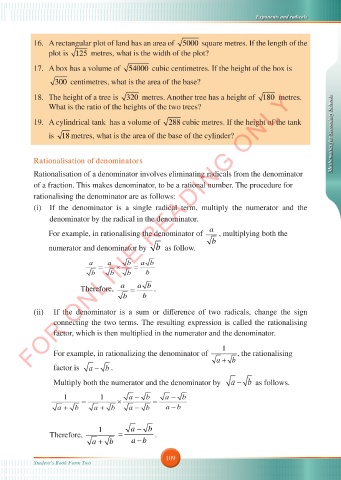
           Rationalisation of denominators

           Rationalisation of a denominator involves eliminating radicals from the denominator
           of a fraction. This makes denominator, to be a rational number. The procedure for
           rationalising the denominator are as follows:
           (i)    If the denominator  is a single radical  term, multiply  the numerator and the
                denominator by the radical in the denominator.

                For example, in rationalising the denominator of   a  , multiplying both the
                                                                 b
                numerator and denominator by  b  as follow.

                            a  =  a  ´  b  =  ab
                             b    b    b     b

                         Therefore,   a  =  ab  .
                                      b     b

           (ii)      If  the  denominator  is  a  sum  or  difference  of  two  radicals,  change the sign
                 connecting the two terms. The resulting expression is called the rationalising
                 factor, which is then multiplied in the numerator and the denominator.

                                                                    1
                 For example, in rationalizing the denominator of        . , the rationalising
                                                                   a +  b
                 factor is  a      .   b -

                 Multiply both the numerator and the denominator by  a          b -    as follows.


                    1     =    1    ´   a    b -  =  a  b -
                                                     -
                  a     b +  a     b +  a    b -   ab

                               1         a −  b
                Therefore,          .   =       .
                                          −
                             a +  b      ab

                                                   109
           Student's Book Form Two


                                                                                          11/10/2024   20:12:34
     MATHEMATIC F2 v5.indd   109                                                          11/10/2024   20:12:34
     MATHEMATIC F2 v5.indd   109

