


Page 147 - Physics_Form_2
P. 147
Nature and reflection of light

                                                                     Reflected
                                                                     rays
                Incident rays
                                                          Incident rays


          FOR ONLINE READING ONLY
              Principal axis                             Principal axis            F      C
              C                     P                                  P


              Reflected rays               Principal
                                 f         focus (F)                          f

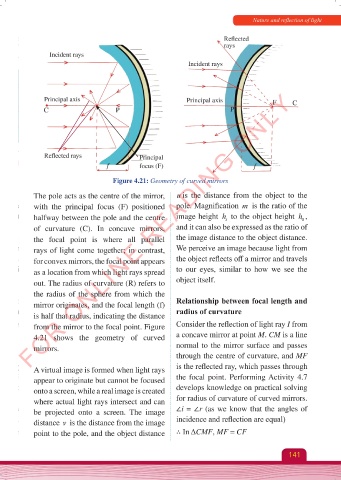
                                   Figure 4.21: Geometry of curved mirrors

           The pole acts as the centre of the mirror,   u is the distance  from the object  to  the
           with the  principal focus (F) positioned   pole. Magnification  m  is the ratio of the
           halfway between the pole and the centre    image height  h  to the object height  h ,
                                                                     i
                                                                                            0
           of curvature  (C). In concave mirrors,     and it can also be expressed as the ratio of
           the focal point is where all parallel      the image distance to the object distance.
           rays of light come together; in contrast,   We perceive an image because light from
           for convex mirrors, the focal point appears   the object reflects off a mirror and travels
           as a location from which light rays spread   to our eyes, similar  to how we see the
           out. The radius of curvature (R) refers to   object itself.
           the radius of the sphere from which the
           mirror originates, and the focal length (f)   Relationship between focal length and

           is half that radius, indicating the distance   radius of curvature
           from the mirror to the focal point. Figure   Consider the reflection of light ray I from
           4.21 shows the  geometry of curved         a concave mirror at point M. CM is a line
           mirrors.                                   normal to the mirror surface and passes
                                                      through the centre of curvature, and MF

           A virtual image is formed when light rays   is the reflected ray, which passes through
           appear to originate but cannot be focused   the focal point. Performing Activity 4.7
           onto a screen, while a real image is created   develops knowledge on practical solving
           where actual light rays intersect and can   for radius of curvature of curved mirrors.
           be  projected  onto  a  screen.  The  image   ∠i = ∠r (as we know that the angles of
           distance v  is the distance from the image   incidence and reflection are equal)
           point to the pole, and the object distance   ∴ In ΔCMF, MF = CF


                                                                                        141


     Physics Form 2 Final.indd   141                                                        25/10/2025   10:27

