


Page 152 - Physics_Form_2
P. 152
Physics for Secondary Schools
Images formed by convex mirrors
In convex mirrors, the the centre of
I 40 cm curvature, C, and the focal point, F, are
located behind the mirror, that is, on the
side of the mirror opposite the reflecting
surface. Thus, a convex mirror has a
FOR ONLINE READING ONLY
negative focal length.
C I F 15 cm
O
A convex mirror is sometimes referred
to as a diverging mirror because incident
h i
light rays diverge upon reflection from the
V
mirror surface. As a result, the reflected
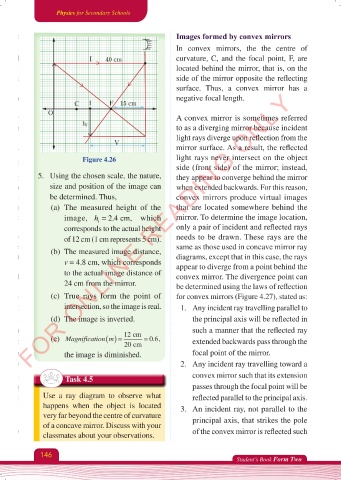
Figure 4.26 light rays never intersect on the object
side (front side) of the mirror; instead,
5. Using the chosen scale, the nature, they appear to converge behind the mirror
size and position of the image can when extended backwards. For this reason,
be determined. Thus, convex mirrors produce virtual images
(a) The measured height of the that are located somewhere behind the
image, h = 2.4 cm, which mirror. To determine the image location,
i
corresponds to the actual height only a pair of incident and reflected rays
of 12 cm (1 cm represents 5 cm). needs to be drawn. These rays are the
(b) The measured image distance, same as those used in concave mirror ray
diagrams, except that in this case, the rays
v = 4.8 cm, which corresponds appear to diverge from a point behind the
to the actual image distance of convex mirror. The divergence point can
24 cm from the mirror. be determined using the laws of reflection
(c) True rays form the point of for convex mirrors (Figure 4.27), stated as:
intersection, so the image is real. 1. Any incident ray travelling parallel to
(d) The image is inverted. the principal axis will be reflected in
such a manner that the reflected ray
(e) Magnification m 12 cm 0.6, extended backwards pass through the
20 cm
the image is diminished. focal point of the mirror.
2. Any incident ray travelling toward a
Task 4.5 convex mirror such that its extension
passes through the focal point will be
Use a ray diagram to observe what reflected parallel to the principal axis.
happens when the object is located 3. An incident ray, not parallel to the
very far beyond the centre of curvature
of a concave mirror. Discuss with your principal axis, that strikes the pole
classmates about your observations. of the convex mirror is reflected such
146
Student’s Book Form Two
Physics Form 2 Final.indd 146 25/10/2025 10:27

