


Page 155 - Physics_Form_2
P. 155
Nature and reflection of light
to diverge from the principal focus F, image distance,
while the ray ON is reflected along 1 cm 5 cm
its original path, hence appearing to v 1 cm 5 cm
come from C.
5. The image of the object is formed height of image,
at the point of intersection of lines 0.5 cm 5 cm
FOR ONLINE READING ONLY
AF and NC. h i 1 cm 2.5 cm
6. Measure the image distance, v and
height of the image, h . 8. Virtual rays form the point of
i
7. Since the scale is l cm to 5 cm, it intersection, so the image is virtual.
then follows that: 9. The image is upright and diminished.
Curved mirror formula
Ray diagrams provide valuable information for determining the approximate location
and size of the image. However, they do not deliver accurate numerical information
concerning image distance and size. This is due to several errors that can arise from
various sources when creating ray diagrams. Therefore, to obtain more precise numerical
information, one should use the mirror equation and the magnification equation. The
mirror equation provides the quantitative relationship between the object distance
(u ), the image distance ( v ), and the focal length ( f ). This equation is derived using
the geometry of either concave or convex mirrors.
R
Optical O' A
h
o φ Image θ axis
Object C ′ φ ′ θ h i C I P
O F
I'
v
u
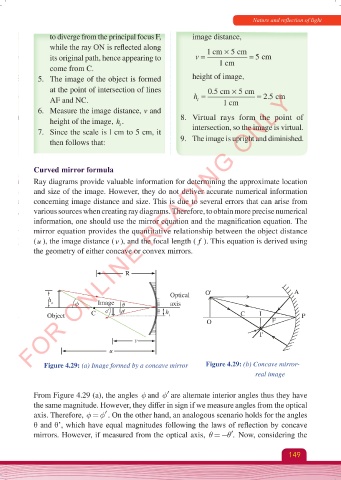
Figure 4.29: (a) Image formed by a concave mirror Figure 4.29: (b) Concave mirror-
real image
From Figure 4.29 (a), the angles φ and ′ φ are alternate interior angles thus they have
the same magnitude. However, they differ in sign if we measure angles from the optical
axis. Therefore, φ = ′ φ . On the other hand, an analogous scenario holds for the angles
θ and θ’, which have equal magnitudes following the laws of reflection by concave
mirrors. However, if measured from the optical axis, θ =− ′ θ . Now, considering the
149
Physics Form 2 Final.indd 149 25/10/2025 10:27

