


Page 160 - Physics_Form_2
P. 160
Physics for Secondary Schools
pole, so the object is beyond the centre of
1 1 1 curvature, C.
v 12 cm 30 cm
5 cm 2 cm 1
3 30 cm Concave mirror Candle Screen
FOR ONLINE READING ONLY
60 cm
v = = 20 cm
3
Since the image distance is
positive, the image is real. To
find the height of the image, we
apply the magnification formula:
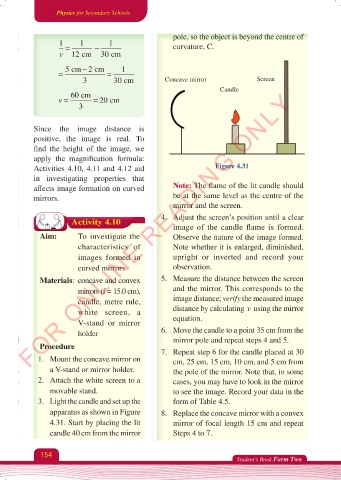
Activities 4.10, 4.11 and 4.12 aid Figure 4.31
in investigating properties that
affects image formation on curved Note: The flame of the lit candle should
mirrors. be at the same level as the centre of the
mirror and the screen.
4. Adjust the screen’s position until a clear
Activity 4.10
image of the candle flame is formed.
Aim: To investigate the Observe the nature of the image formed.
characteristics of Note whether it is enlarged, diminished,
images formed in upright or inverted and record your
curved mirrors observation.
Materials: concave and convex 5. Measure the distance between the screen
mirrors (f = 15.0 cm), and the mirror. This corresponds to the
candle, metre rule, image distance; verify the measured image
white screen, a distance by calculating v using the mirror
V-stand or mirror equation.
holder 6. Move the candle to a point 35 cm from the
mirror pole and repeat steps 4 and 5.
Procedure 7. Repeat step 6 for the candle placed at 30
1. Mount the concave mirror on cm, 25 cm, 15 cm, 10 cm, and 5 cm from
a V-stand or mirror holder. the pole of the mirror. Note that, in some
2. Attach the white screen to a cases, you may have to look in the mirror
movable stand. to see the image. Record your data in the
3. Light the candle and set up the form of Table 4.5.
apparatus as shown in Figure 8. Replace the concave mirror with a convex
4.31. Start by placing the lit mirror of focal length 15 cm and repeat
candle 40 cm from the mirror Steps 4 to 7.
154
Student’s Book Form Two
Physics Form 2 Final.indd 154 25/10/2025 10:27

