


Page 157 - Physics_Form_2
P. 157
Nature and reflection of light
Derivation 5. Set up a ratio
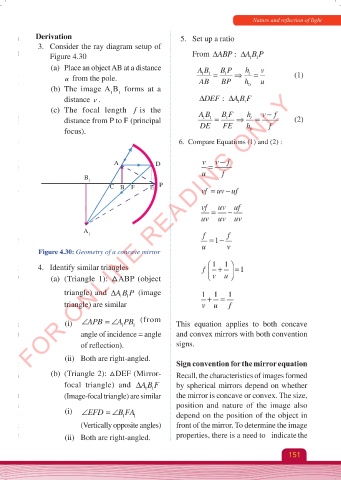
3. Consider the ray diagram setup of
Figure 4.30 From ABP : A B P
11
(a) Place an object AB at a distance AB B P h v
1
11
u from the pole. AB BP h i u (1)
(b) The image A B forms at a 0
FOR ONLINE READING ONLY
1 1
distance v . DEF : A B F
11
(c) The focal length f is the AB B F h v f
1
11
distance from P to F (principal DE FE h i f (2)
focus). 0
6. Compare Equations (1) and (2) :
A D v v f
u f
B
1
C B F E P
vf uv uf
vf uv uf
uv uv uv
A 1 f f
1
u v
Figure 4.30: Geometry of a concave mirror
4. Identify similar triangles f 1 1 1
(a) (Triangle 1): △ABP (object v u
triangle) and AB P 11 (image 1 1 1
triangle) are similar v + u = f
(i) APB A PB 1 (from This equation applies to both concave
1
angle of incidence = angle and convex mirrors with both convention
of reflection). signs.
(ii) Both are right-angled.
Sign convention for the mirror equation
(b) (Triangle 2): △DEF (Mirror- Recall, the characteristics of images formed
focal triangle) and AB F by spherical mirrors depend on whether
11
(Image-focal triangle) are similar the mirror is concave or convex. The size,
(i) EFD B FA 1 position and nature of the image also
depend on the position of the object in
1
(Vertically opposite angles) front of the mirror. To determine the image
(ii) Both are right-angled. properties, there is a need to indicate the
151
Physics Form 2 Final.indd 151 25/10/2025 10:27

