


Page 154 - Physics_Form_2
P. 154
Physics for Secondary Schools
7. Use dashed lines to extend Example 4.4
the reflected rays behind the
mirror until they intersect. An object 5 cm long is placed on and
The point of intersection is perpendicular to the principal axis of a convex
the image point of the top of mirror of radius of curvature 20 cm. Use a
the object. scaled diagram to find the position, size and
FOR ONLINE READING ONLY
8. Use an arrow to draw the nature of the image when the object is 10 cm
from the pole of the mirror.
image by joining the point
of intersection of extended
rays and the principal axis. Solution
9. Measure the image distance The height of the object is 5 cm, the object
distance is 10 cm, the radius of curvature is
v, the object distance u, the 20 cm, and the focal length is 10 cm .
image height, h and the
i
object height, h Note that, Scale: 1 cm represents 5 cm.
.
o
distances measured behind From the scale:
the mirror are considered to
be negative. Height of object = l cm, object distance =
10. Repeat Steps 3 to 9 for 2 cm and focal length 2 cm
different positions of the 1. Draw a convex mirror with the pole P.
object. 2. Locate the focal point and object position
11. Summarise the results in a by using the provided values.
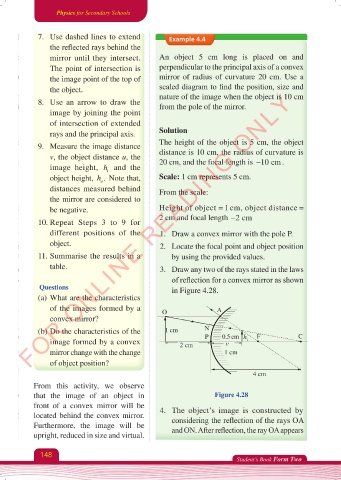
table. 3. Draw any two of the rays stated in the laws
of reflection for a convex mirror as shown
Questions in Figure 4.28.
(a) What are the characteristics
of the images formed by a O A
convex mirror?
(b) Do the characteristics of the 1 cm N
image formed by a convex 2 cm P 0.5 cm h i F C
v
mirror change with the change 1 cm
of object position?
4 cm
From this activity, we observe
that the image of an object in Figure 4.28
front of a convex mirror will be
located behind the convex mirror. 4. The object’s image is constructed by
Furthermore, the image will be considering the reflection of the rays OA
upright, reduced in size and virtual. and ON. After reflection, the ray OA appears
148
Student’s Book Form Two
Physics Form 2 Final.indd 148 25/10/2025 10:27

