


Page 148 - Physics_Form_2
P. 148
Physics for Secondary Schools


                  I                   M              Materials: concave mirror, black carbon
                               i                                paper, metre rule
                                r
                           i              P          Procedure
                         C     F                    1.  Hold a concave mirror in such a way
                                                        that its reflecting surface faces towards
          FOR ONLINE READING ONLY
                                                        the Sun.
                            R
                                                    2.  Adjust the position of the concave mirror
                        Figure 4.22:                    so that the Sun’s image falls on the piece

           For a small  aperture  of the mirror         of carbon paper after reflecting from the
                                                        mirror.
           around the vertex,                       3.  Adjust the position of the carbon paper
             MF =  PF                                   until you find a bright, sharp spot of light
             PC =  PF CF+   =  PF +  PF =   2PF         on the paper sheet.
             R =   2 f                              4.  Measure the distance between the mirror
                           R                            and the paper with the help of the metre
           Therefore,  f =                              rule.
                           2
                                                    5.  Hold both the mirror and the paper for
                       Activity 4.7                     a few minutes in the same position and
                                                        observe what happens.
             Aim:        To determine the
                         approximate value of       Questions
                         the radius of curvature    What is the length of the radius of curvature
                         of a concave mirror        of the mirror?


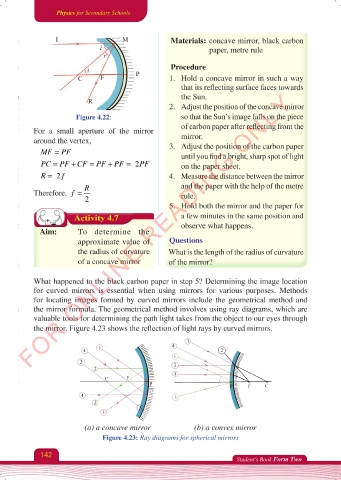
           What happened to the black carbon paper in step 5? Determining the image location
           for curved mirrors is essential when using mirrors for various purposes.  Methods
           for locating images formed by curved mirrors include the geometrical method and
           the mirror formula. The geometrical method involves using ray diagrams, which are
           valuable tools for determining the path light takes from the object to our eyes through
           the mirror. Figure 4.23 shows the reflection of light rays by curved mirrors.


                           (a) a concave mirror                      (b) a convex mirror
                                Figure 4.23: Ray diagrams for spherical mirrors

             142
                                                                         Student’s Book Form Two


     Physics Form 2 Final.indd   142                                                        25/10/2025   10:27

