


Page 167 - Physics_Form_2
P. 167
Nature and reflection of light

             6.  A convex mirror is a mirror that curves outward, producing smaller images and
                a wider field of view.
             7.  A virtual image is formed by the apparent divergence of light rays, which cannot
                be projected onto a screen (e.g., images in a plane mirror).
             8.  Real image is an image formed by the actual convergence of light rays, which can
                be projected onto a screen.
          FOR ONLINE READING ONLY
             9.  Focal point is the point at which parallel light rays converge after reflecting off a
                concave mirror.
             10. Magnification (m) is the ratio of the height of the image to the height of the object,
                indicating how much larger or smaller the image is compared to the object.

                      Revision Exercise 4


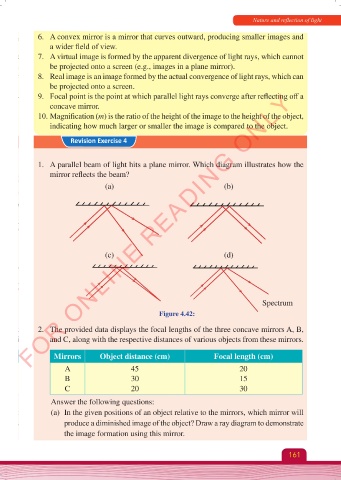
             1.  A parallel beam of light hits a plane mirror. Which diagram illustrates how the
                mirror reflects the beam?
                                 (a)                                 (b)


                                 (c)                                 (d)


                                                                                Spectrum
                                                 Figure 4.42:

             2.  The provided data displays the focal lengths of the three concave mirrors A, B,
                and C, along with the respective distances of various objects from these mirrors.

                 Mirrors       Object distance (cm)               Focal length (cm)

                     A                   45                              20
                     B                   30                              15
                     C                   20                              30

                Answer the following questions:
                (a)  In the given positions of an object relative to the mirrors, which mirror will
                    produce a diminished image of the object? Draw a ray diagram to demonstrate
                    the image formation using this mirror.


                                                                                        161


     Physics Form 2 Final.indd   161                                                        25/10/2025   10:27

