


Page 170 - Physics_Form_2
P. 170
Physics for Secondary Schools


             3.  In a straight line, slowly move away from the bucket to a point where the coin is
                just outside your line of view. That is, the coin is not visible. Mark this point as
                M.
             4.  Pour gently clear water into the bucket and try to view the coin while standing at
                point M.
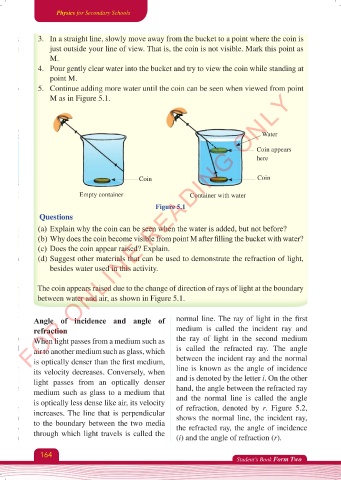
             5.  Continue adding more water until the coin can be seen when viewed from point
          FOR ONLINE READING ONLY
                M as in Figure 5.1.


                                                                                Water

                                                                               Coin appears
                                                                               here


                                           Coin                                Coin

                         Empty container                  Container with water
                                                Figure 5.1
             Questions
             (a) Explain why the coin can be seen when the water is added, but not before?
             (b) Why does the coin become visible from point M after filling the bucket with water?
             (c) Does the coin appear raised? Explain.
             (d) Suggest other materials that can be used to demonstrate the refraction of light,
                besides water used in this activity.

            The coin appears raised due to the change of direction of rays of light at the boundary
            between water and air, as shown in Figure 5.1.


           Angle  of  incidence  and  angle  of       normal line. The ray of light in the first
           refraction                                 medium  is called  the  incident  ray and
           When light passes from a medium such as    the  ray of light  in the  second medium
           air to another medium such as glass, which   is  called  the  refracted  ray.  The  angle
           is optically denser than the first medium,   between the incident ray and the normal
           its velocity decreases. Conversely, when   line is known as the angle of incidence
           light  passes from an optically  denser    and is denoted by the letter i. On the other
           medium such as glass to a medium that      hand, the angle between the refracted ray
           is optically less dense like air, its velocity   and the normal line is called the angle
                                                      of refraction, denoted  by  r. Figure 5.2,
           increases. The line that is perpendicular   shows the normal line, the incident ray,
           to the boundary between the two media      the refracted ray, the angle of incidence
           through which light travels is called the
                                                      (i) and the angle of refraction (r).

             164
                                                                         Student’s Book Form Two


     Physics Form 2 Final.indd   164                                                        25/10/2025   10:27

