


Page 171 - Physics_Form_2
P. 171
Refraction and dispersion of light

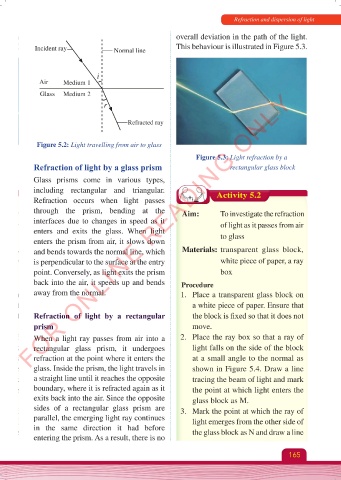
                                                      overall deviation in the path of the light.
            Incident ray           Normal line        This behaviour is illustrated in Figure 5.3.


                              i
             Air    Medium 1
          FOR ONLINE READING ONLY
             Glass  Medium 2
                                r

                                        Refracted ray


            Figure 5.2: Light travelling from air to glass

                                                            Figure 5.3: Light refraction by a
           Refraction of light by a glass prism                                   rectangular glass block

           Glass prisms come  in  various  types,
           including  rectangular  and triangular.                Activity 5.2
           Refraction  occurs  when light  passes
           through the prism, bending at the            Aim:        To investigate the refraction
           interfaces due to changes in speed as it                 of light as it passes from air
           enters and exits the glass.  When light
           enters the prism from air, it slows down                 to glass
           and bends towards the normal line, which     Materials:  transparent glass block,
           is perpendicular to the surface at the entry             white piece of paper, a ray
           point. Conversely, as light exits the prism              box
           back into the air, it speeds up and bends    Procedure
           away from the normal.                        1.  Place a transparent glass block on

                                                           a white piece of paper. Ensure that
           Refraction  of  light  by  a  rectangular       the block is fixed so that it does not
           prism                                           move.
           When a light ray passes from air into a      2.  Place the ray box so that a ray of
           rectangular  glass prism, it  undergoes         light falls on the side of the block
           refraction at the point where it enters the     at a small angle to the normal as
           glass. Inside the prism, the light travels in   shown in Figure 5.4. Draw a line
           a straight line until it reaches the opposite   tracing the beam of light and mark
           boundary, where it is refracted again as it     the point at which light enters the
           exits back into the air. Since the opposite     glass block as M.
           sides of a rectangular  glass prism are      3.  Mark the point at which the ray of
           parallel, the emerging light ray continues      light emerges from the other side of
           in the same direction  it had before            the glass block as N and draw a line
           entering the prism. As a result, there is no

                                                                                        165


     Physics Form 2 Final.indd   165                                                        25/10/2025   10:27

