


Page 176 - Physics_Form_2
P. 176
Physics for Secondary Schools


           Thus,  c = η v = η v                         Materials:  concave mirrors of different
                       1 1   2 2
                                                                    focal lengths (10 cm, 15
           Hence, η v = η v                                         cm, 20 cm and 25 cm),
                    1 1   2 2
                                                                    water, retort stand, optical
           This expression can be rearranged to read:               pin, clamp, meter rule,

             η    v                                                 computer or tablet with
          FOR ONLINE READING ONLY
               2  =  1
             η    v                                                 spreadsheet software
              1    2
                      η
           The ratio    2  is the relative  refractive
                      η                                 Procedure
                        1
           index  of  glass  to  water.  This  ratio  can   1.  Place a concave mirror on a bench.
           also be related to the ratio of the sines of   2.  Clamp an optical pin on the retort
           the  angle of incidence  and the  angle  of     stand above the concave mirror.
           refraction as follows.                       3.  Position one eye vertically above the
              η     sin(i)                                 pin and look in the concave mirror
               2  =                                        for the real inverted image of the pin.
                 η 1  sin(r)
                                                        4.  Adjust the position of the optical pin
           Therefore, η sin(i) = η sin(r)                  by moving it up or down until the
                       1
                                 2
                                                           pin image coincides with the real pin
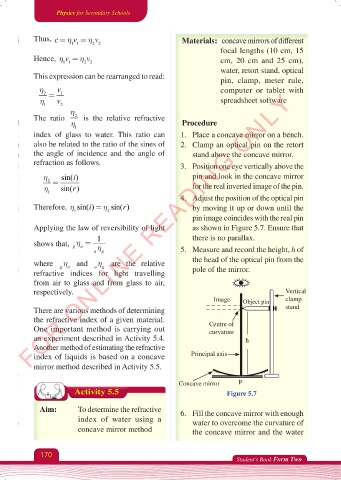
           Applying the law of reversibility of light      as shown in Figure 5.7. Ensure that
                              1                            there is no parallax.
           shows that,  η =
                       g
                         a
                             a η g                      5.  Measure and record the height, h of
           where   g η a    and   a η g    are  the  relative   the head of the optical pin from the
           refractive  indices for light travelling        pole of the mirror.
           from air to glass and from glass to air,
           respectively.                                                               Vertical
                                                                  Image   Object pin   clamp
           There are various methods of determining                                    stand
           the refractive index of a given material.            Centre of
           One important method is carrying out                 curvature
           an experiment described in Activity 5.4.                        h
           Another method of estimating the refractive
           index of liquids is based on a concave          Principal axis
           mirror method described in Activity 5.5.


                                                       Concave mirror    P
                        Activity 5.5                                  Figure 5.7

             Aim:        To determine the refractive    6.  Fill the concave mirror with enough
                         index of water using a            water to overcome the curvature of
                         concave mirror method             the concave mirror and the water


             170
                                                                         Student’s Book Form Two


     Physics Form 2 Final.indd   170                                                        25/10/2025   10:27

