


Page 173 - Physics_Form_2
P. 173
Refraction and dispersion of light

                                                      various experimental  observations, two
                                                      laws govern the behaviour of a light ray
                                                      as it  strikes  the  interface  between  two
                                                      media of different optical densities. These
                                                      laws are known as the laws of refraction
                                         Glass block
                                                      of light.
          FOR ONLINE READING ONLY


                                                                  Activity 5.4

                                                        Aim:        To deduce the laws of
                                                                    refraction and determine
                                                                    the refractive index
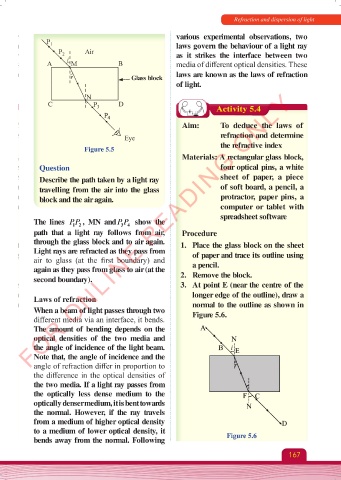
                           Figure 5.5
                                                        Materials: A rectangular glass block,
             Question                                               four optical pins, a white
             Describe the path taken by a light ray                 sheet of paper, a piece
             travelling from the air into the glass                 of soft board, a pencil, a
             block and the air again.                               protractor, paper pins, a
                                                                    computer or tablet with
                                                                    spreadsheet software
           The lines  PP , MN and P P  show the
                                      34
                       12
           path that a light ray follows  from air,     Procedure
           through the glass block and to air again.    1.  Place the glass block on the sheet
           Light rays are refracted as they pass from      of paper and trace its outline using
           air  to  glass  (at  the  first  boundary)  and   a pencil.
           again as they pass from glass to air (at the
           second boundary).                            2.  Remove the block.
                                                        3.  At point E (near the centre of the
                                                           longer edge of the outline), draw a
           Laws of refraction                              normal to the outline as shown in
           When a beam of light passes through two         Figure 5.6.
           different media via an interface, it bends.
           The  amount  of bending  depends  on the
           optical  densities of the  two media  and
           the angle of incidence of the light beam.
           Note that, the angle of incidence and the
           angle of refraction differ in proportion to
           the difference in the optical densities of
           the two media. If a light ray passes from
           the optically  less dense medium  to the
           optically denser medium, it is bent towards
           the normal. However, if the ray travels
           from a medium of higher optical density
           to a medium of lower optical density, it
           bends away from the normal. Following                      Figure 5.6

                                                                                        167


     Physics Form 2 Final.indd   167                                                        25/10/2025   10:27

