


Page 174 - Physics_Form_2
P. 174
Physics for Secondary Schools
4. Draw a line at an angle to the outline, Questions
for example, 30°, to meet the outline (a) Calculate the ratio sin( )i for each
at E. sin( )r
5. Place the paper on the soft board and pair of angles and record your
hold it in position with the help of result in the table.
FOR ONLINE READING ONLY
paper pins. (b) Use spreadsheet software to input
6. Stick two optical pins, A and B on your data from Table 5.1. Create a
the line you drew. Replace the glass graph to visualise the relationship
block back on the outline. between the angle of incidence
7. View through the block from the and the calculated ratio.
opposite side and place pins C and (c) What conclusion can you draw
D so that all four pins appear in a from the values of sin( )i for the
straight line. sin( )r
8. Remove the block and draw a line different angles of incidence i ?
through the marks made by pins C
and D. Mark the point of intersection Several deductions can be made from the
of the line through C and D and the results of the above experiment:
glass block outline as F. 1. Whenever the pins are set in line and
9. Join points F and E with a straight viewed from one side, they appear
line and then draw a normal line to to be in line. This is also the case
the glass block outline at E and F as
shown in Figure 5.6. when pins are viewed from the other
10. Measure the angle of incidence and side. This illustrates the principle of
the angle of refraction at the first reversibility of light, which states
boundary. that; "light will follow exactly the
same path if its direction of travel is
Repeat the experiment for different reversed". The implication of the law
angles of incidence and record results of reversibility of light in a rectangular
in the format shown in Table 5.1. glass prism is that, if i is the angle of
incidence from air to glass and r is the
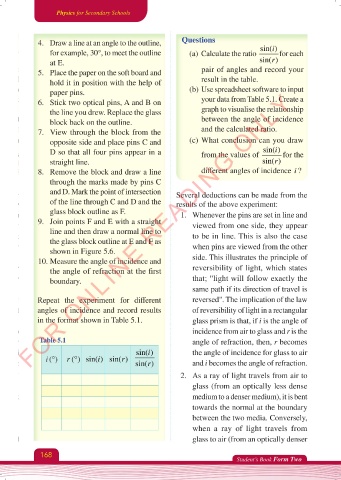
Table 5.1 angle of refraction, then, r becomes
sin( )i the angle of incidence for glass to air
i () r () sin( )i sin( )r sin( )r and i becomes the angle of refraction.
2. As a ray of light travels from air to
glass (from an optically less dense
medium to a denser medium), it is bent
towards the normal at the boundary
between the two media. Conversely,
when a ray of light travels from
glass to air (from an optically denser
168
Student’s Book Form Two
Physics Form 2 Final.indd 168 25/10/2025 10:27

