


Page 179 - Physics_Form_2
P. 179
Refraction and dispersion of light
θ = 90°
Air 1 Air
θ c
FOR ONLINE READING ONLY
Water Water
(a) (b)
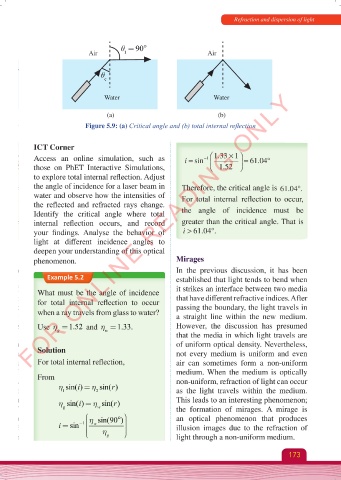
Figure 5.9: (a) Critical angle and (b) total internal reflection
ICT Corner
Access an online simulation, such as i sin 1 1.33 1 61.04
those on PhET Interactive Simulations, 1.52
to explore total internal reflection. Adjust
the angle of incidence for a laser beam in Therefore, the critical angle is 61.04 .
water and observe how the intensities of For total internal reflection to occur,
the reflected and refracted rays change.
Identify the critical angle where total the angle of incidence must be
internal reflection occurs, and record greater than the critical angle. That is
your findings. Analyse the behavior of i 61.04 .
light at different incidence angles to
deepen your understanding of this optical
phenomenon. Mirages
In the previous discussion, it has been
Example 5.2 established that light tends to bend when
What must be the angle of incidence it strikes an interface between two media
for total internal reflection to occur that have different refractive indices. After
passing the boundary, the light travels in
when a ray travels from glass to water? a straight line within the new medium.
Use η =1.52 and η =1.33. However, the discussion has presumed
g
w
that the media in which light travels are
of uniform optical density. Nevertheless,
Solution not every medium is uniform and even
For total internal reflection, air can sometimes form a non-uniform
medium. When the medium is optically
From non-uniform, refraction of light can occur
η sin(i) = η sin(r)
1 2 as the light travels within the medium.
η sin(i) = η sin(r) This leads to an interesting phenomenon;
the formation of mirages. A mirage is
g
w
⎛
⎞
−1⎜ η sin(90°)⎟ an optical phenomenon that produces
i = sin ⎜ w ⎟ illusion images due to the refraction of
⎟
⎜
⎟
⎝
⎠
⎜ ⎜ η g ⎟ light through a non-uniform medium.
173
Physics Form 2 Final.indd 173 25/10/2025 10:28

