Page 184 - Physics_Form_2
P. 184

Physics for Secondary Schools


           Angle of minimum deviation of a prism             The sum of internal angles is 180
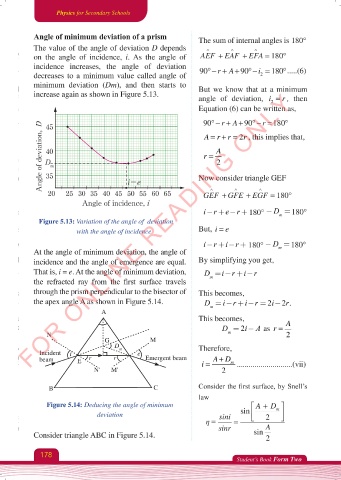
           The value of the angle of deviation D depends                    
           on the angle of incidence,  i.  As  the angle of   AEF   EAF   EFA   180
           incidence  increases, the angle of deviation      90  rA   90    180.....(6)
                                                                               i
           decreases to a minimum value called angle of                         2
           minimum  deviation (Dm), and then starts to       But we know that at a minimum
          FOR ONLINE READING ONLY
           increase again as shown in Figure 5.13.
                                                                                      r
                                                             angle  of deviation,  i = , then
                                                                                   2
                                                             Equation (6) can be written as,
                                                                    r
                                                                                r
                                                               90 
                                                                       A
                                                                           90 
                                                                                    180
              Angle of deviation, D  D m                       r =  A    2r , this implies that,
               45
                                                               A =+ =
                                                                   rr
               40
                                                                  2
               35
                                        i=e
                                                                               
                                                                        
                                                                 
                                                                      GFE 
                                                                                     180
                                                              GEF 
               20    25 30 35 40 45 50 55 60 65              Now consider triangle GEF
                                                                             EGF 
                          Angle of incidence, i
                                                                    90  A
                                                                A 90
                                                               i−r +e−r +180°− D = 180° − D = 180°
                                                       90  i−r +e−r +180° 90r r    180    m m r   180
                                                             r
              Figure 5.13: Variation of the angle of  deviation
                             with the angle of incidence     But, i =  e
                                                               i−r +i−r +180°− D = 180° − D = 180°
                                                                A 90
                                                       90  i−r +e−r +180° 90r r  180    r   180
                                                                   90  A
                                                            r
           At the angle of minimum deviation, the angle of                          m m
           incidence and the angle of emergence are equal.   By simplifying you get,
           That is, i = e. At the angle of minimum deviation,   D =i−r +i−r
           the  refracted  ray  from  the  first  surface  travels   m
           through the prism perpendicular to the bisector of   This becomes,
           the apex angle A as shown in Figure 5.14.            D = i−r +i−r = 2i−2r.
                                A                               m
                                                             This becomes,
                                                                         D = 2i− A as  r =  A
               N                                                      m                 2
                                 G            M
                                    D m                      Therefore,
             Incident   i i                e
             beam       E   r      r         Emergent beam    i =  AD+  m  ............................(vii)
                             N'    M'                               2
                B                              C             Consider the first surface, by Snell’s
                                                             law
               Figure 5.14: Deducing the angle of minimum                      A   D   m
                              deviation                            sini   sin     2    
                                                               η=       
                                                                   sinr          A
           Consider triangle ABC in Figure 5.14.                              sin  2


             178
                                                                         Student’s Book Form Two


     Physics Form 2 Final.indd   178                                                        25/10/2025   10:28
   179   180   181   182   183   184   185   186   187   188   189