


Page 189 - Physics_Form_2
P. 189
Refraction and dispersion of light
Questions
(a) Why does the sunlight shining through water drops make a rainbow?
(b) Why must you stand with your back toward the sun to see a rainbow?
(c) Can a person standing beside you also see the rainbow?
FOR ONLINE READING ONLY
When you look at a rainbow, you see seven colours. They are always in the same order.
That is red, orange, yellow, green, blue, indigo, and violet. An easy way to remember
the colours and the order is to think of the name ROYGBIV, spelt from the first letter
of each colour.
Primary rainbow
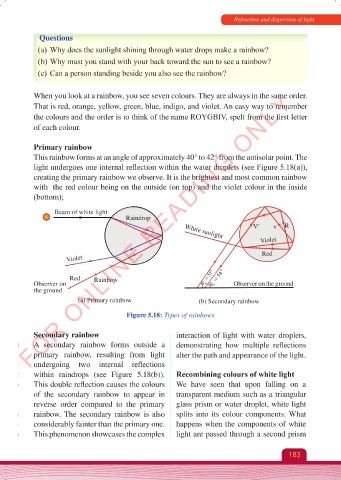
This rainbow forms at an angle of approximately 40° to 42° from the antisolar point. The
light undergoes one internal reflection within the water droplets (see Figure 5.18(a)),
creating the primary rainbow we observe. It is the brightest and most common rainbow
with the red colour being on the outside (on top) and the violet colour in the inside
(bottom);
Beam of white light R'
Raindrop
V' v R
White sunlight
Violet
Violet Red
Red Rainbow = 51° 180 = 54° 180
Observer on θ R θ V Observer on the ground
the ground
(a) Primary rainbow (b) Secondary rainbow
Figure 5.18: Types of rainbows
Secondary rainbow interaction of light with water droplets,
A secondary rainbow forms outside a demonstrating how multiple reflections
primary rainbow, resulting from light alter the path and appearance of the light.
undergoing two internal reflections
within raindrops (see Figure 5.18(b)). Recombining colours of white light
This double reflection causes the colours We have seen that upon falling on a
of the secondary rainbow to appear in transparent medium such as a triangular
reverse order compared to the primary glass prism or water droplet, white light
rainbow. The secondary rainbow is also splits into its colour components. What
considerably fainter than the primary one. happens when the components of white
This phenomenon showcases the complex light are passed through a second prism
183
Physics Form 2 Final.indd 183 25/10/2025 10:28

