


Page 193 - Physics_Form_2
P. 193
Refraction and dispersion of light

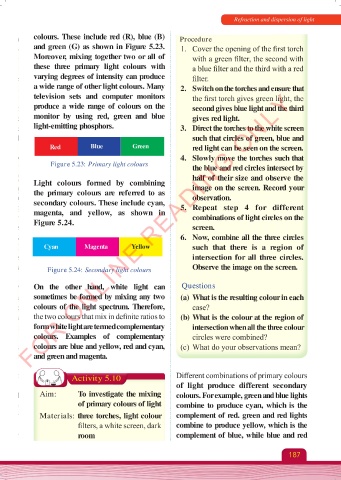
           colours. These include red (R), blue (B)    Procedure
           and green (G) as shown in Figure 5.23.       1.  Cover the opening of the first torch
           Moreover, mixing together two or all of         with a green filter, the second with
           these three primary light colours with          a blue filter and the third with a red
           varying degrees of intensity can produce        filter.
           a wide range of other light colours. Many    2.  Switch on the torches and ensure that
                                         YellowREADING ONLY
           television  sets and computer monitors          the first torch gives green light, the
           produce a wide range of colours on the          second gives blue light and the third
           monitor by using red, green and blue            gives red light.
           light-emitting phosphors.                    3.  Direct the torches to the white screen
                                                           such that circles of green, blue and
                Red         Blue         Green             red light can be seen on the screen.
                                                        4.  Slowly move the torches such that
                Figure 5.23: Primary light colours
                                                           the blue and red circles intersect by
                                                           half of their size and observe the
           Light colours formed by combining               image on the screen. Record your
           the  primary  colours  are  referred  to as     observation.
           secondary colours. These include cyan,       5.  Repeat step 4  for  different
           magenta, and yellow, as shown in                combinations of light circles on the
           Figure 5.24.
                                                           screen.
          FOR ONLINE
                                                        6.  Now, combine all the three circles
              Cyan         Magenta                         such that there is a region of
                                                           intersection for all three circles.
               Figure 5.24: Secondary light colours        Observe the image on the screen.

           On the other hand, white light can           Questions
           sometimes be formed by mixing any two        (a) What is the resulting colour in each
           colours of the light spectrum. Therefore,       case?
           the two colours that mix in definite ratios to   (b) What is the colour at the region of
           form white light are termed complementary       intersection when all the three colour
           colours. Examples of complementary              circles were combined?
           colours are blue and yellow, red and cyan,   (c) What do your observations mean?
           and green and magenta.


                       Activity 5.10                  Different combinations of primary colours
                                                      of  light  produce  different  secondary
             Aim:        To investigate the mixing    colours. For example, green and blue lights
                         of primary colours of light   combine to produce cyan, which is the

             Materials: three torches, light colour   complement of red. green and red lights
                         filters, a white screen, dark   combine to produce yellow, which is the
                         room                         complement of blue, while blue and red


                                                                                        187


     Physics Form 2 Final.indd   187                                                        25/10/2025   10:28

