


Page 196 - Physics_Form_2
P. 196
Physics for Secondary Schools


           because  it  reflects  green  and  red  lights  from   as colour  mixing.  Since  colour-
           the white incident light. Generally, the rules of   mixing  uses  the  concepts  of
           subtraction of light colour are:                  addition  and subtraction  of light
             1.  Red colour absorbs green and blue light     colours,  there  are  two main
                and reflects red light.                      types of colour  mixing.  These
             2.  Blue colour absorbs green and red light and   are additive  colour mixing and
          FOR ONLINE READING ONLY
                reflects blue light.                         subtractive colour mixing.
             3.  Green colour absorbs blue and red light     Additive colour mixing
                while reflecting green light.
             4.  Cyan colour absorbs red light and reflects   Additive  colour mixing  is the
                                                             process of creating a new colour
                cyan light (blue + green).                   by adding one set of colours to
             5.  Magenta colour absorbs green light and      another set of colours.  When we
                reflects magenta light (red + blue).         add all of the different colours of
             6.  Yellow colour absorbs blue light and reflects   sunlight, we see white light rather
                yellow light (red + green).                  than  many  individual  colours.
                                                             Thus, this type  of colour  mixing
           These rules are very important  concepts for      is called  additive  colour  mixing
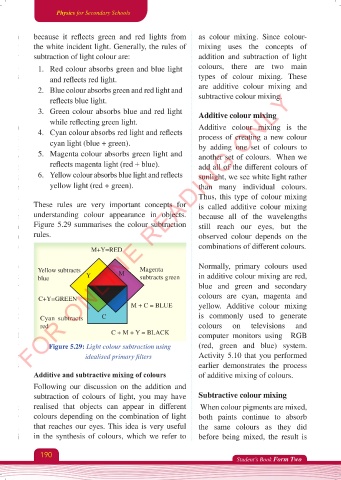
           understanding  colour appearance  in objects.     because all of the wavelengths
           Figure 5.29 summarises the colour subtraction     still reach our eyes, but the
           rules.                                            observed colour depends on the

                             M+Y=RED                         combinations of different colours.


            Yellow subtracts         M     Magenta           Normally, primary  colours  used
            blue           Y               subtracts green   in additive colour mixing are red,
                                                             blue  and green  and secondary

             C+Y=GREEN                                       colours are cyan, magenta and
                                         M + C = BLUE        yellow.  Additive colour mixing
             Cyan  subtracts    C                            is commonly used to generate
             red                                             colours   on    televisions  and
                                   C + M + Y = BLACK         computer  monitors using  RGB
                Figure 5.29: Light colour subtraction using   (red, green and blue) system.
                                idealised primary filters    Activity 5.10 that you performed
                                                             earlier  demonstrates  the  process
           Additive and subtractive mixing of colours        of additive mixing of colours.
           Following our discussion on the addition  and
           subtraction  of colours of light,  you may  have   Subtractive colour mixing
           realised  that  objects  can  appear  in  different    When colour pigments are mixed,
           colours depending on the combination of light     both paints continue to absorb
           that reaches our eyes. This idea is very useful   the  same  colours  as they  did
           in  the  synthesis of colours,  which  we refer  to   before being mixed, the result  is


             190
                                                                         Student’s Book Form Two


     Physics Form 2 Final.indd   190                                                        25/10/2025   10:28

