


Page 199 - Physics_Form_2
P. 199
Refraction and dispersion of light

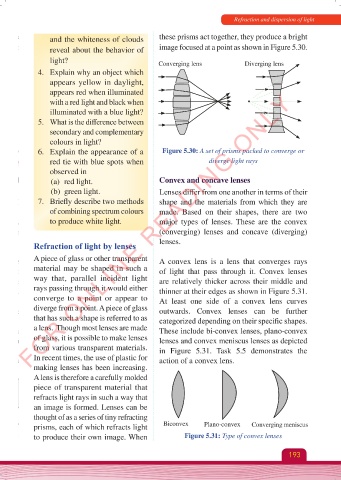
                and the whiteness of clouds      these prisms act together, they produce a bright
                reveal about the behavior of     image focused at a point as shown in Figure 5.30.
                light?                           Converging lens           Diverging lens

             4.  Explain why an object which
                appears yellow in daylight,
          FOR ONLINE READING ONLY
                appears red when illuminated
                with a red light and black when
                illuminated with a blue light?
             5.  What is the difference between
                secondary and complementary
                colours in light?
             6.  Explain the appearance of a      Figure 5.30: A set of prisms packed to converge or
                red tie with blue spots when                    diverge light rays
                observed in
                (a)  red light.                  Convex and concave lenses
                (b)  green light.                Lenses differ from one another in terms of their
             7.  Briefly describe two methods    shape and the materials from which they are
                of combining spectrum colours    made. Based on their shapes, there are two
                to produce white light.          major types of lenses.  These are the convex
                                                 (converging) lenses and concave  (diverging)
           Refraction of light by lenses         lenses.

           A piece of glass or other transparent   A convex  lens  is a  lens  that  converges rays
           material may be shaped in such a      of light  that  pass through  it.  Convex lenses
           way that, parallel incident light     are relatively thicker across their middle and
           rays passing through it would either   thinner at their edges as shown in Figure 5.31.
           converge to a point or appear to      At least  one  side  of a  convex  lens  curves
           diverge from a point. A piece of glass   outwards. Convex  lenses can  be  further
           that has such a shape is referred to as   categorized depending on their specific shapes.
           a lens.  Though most lenses are made   These include bi-convex lenses, plano-convex
           of glass, it is possible to make lenses   lenses and convex meniscus lenses as depicted
           from various transparent materials.   in  Figure  5.31.  Task  5.5  demonstrates  the
           In recent times, the use of plastic for   action of a convex lens.
           making lenses has been increasing.
           A lens is therefore a carefully molded
           piece of transparent material that
           refracts light rays in such a way that
           an image is formed. Lenses can be
           thought of as a series of tiny refracting
           prisms, each of which refracts light   Biconvex     Plano-convex  Converging meniscus
           to produce their own image. When              Figure 5.31: Type of convex lenses

                                                                                        193


     Physics Form 2 Final.indd   193                                                        25/10/2025   10:28

