


Page 201 - Physics_Form_2
P. 201
Refraction and dispersion of light

           Other common terms used are; real image, virtual image, image distance, v, object
           distance, u and magnification, m. All these terms take the same meaning as they were
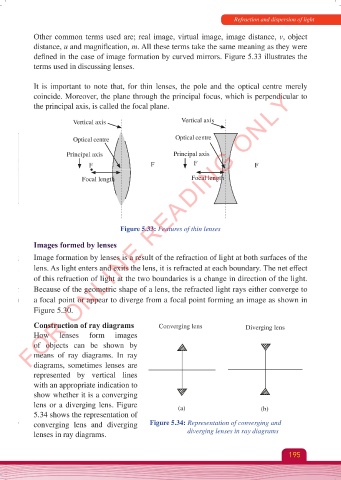
           defined in the case of image formation by curved mirrors. Figure 5.33 illustrates the
           terms used in discussing lenses.

           It is important  to note that, for thin lenses, the pole and the optical  centre merely
          FOR ONLINE READING ONLY
           coincide. Moreover, the plane through the principal focus, which is perpendicular to
           the principal axis, is called the focal plane.

                       Vertical axis                    Vertical axis


                       Optical centre                 Optical centre
                     Principal axis                  Principal axis
                            F                  F            F                 F

                          Focal length                     Focal length


                                     Figure 5.33: Features of thin lenses

           Images formed by lenses

           Image formation by lenses is a result of the refraction of light at both surfaces of the
           lens. As light enters and exits the lens, it is refracted at each boundary. The net effect
           of this refraction of light at the two boundaries is a change in direction of the light.
           Because of the geometric shape of a lens, the refracted light rays either converge to
           a focal point or appear to diverge from a focal point forming an image as shown in
           Figure 5.30.
           Construction of ray diagrams          Converging lens           Diverging lens
           How     lenses   form    images
           of  objects  can  be  shown  by
           means of ray diagrams. In ray
           diagrams,  sometimes  lenses are
           represented  by vertical  lines
           with an appropriate indication to
           show whether it is a converging
           lens or a diverging lens. Figure            (a)                      (b)
           5.34 shows the representation of
           converging lens and diverging      Figure 5.34: Representation of converging and
           lenses in ray diagrams.                            diverging lenses in ray diagrams


                                                                                        195


     Physics Form 2 Final.indd   195                                                        25/10/2025   10:28

