


Page 205 - Physics_Form_2
P. 205
Refraction and dispersion of light


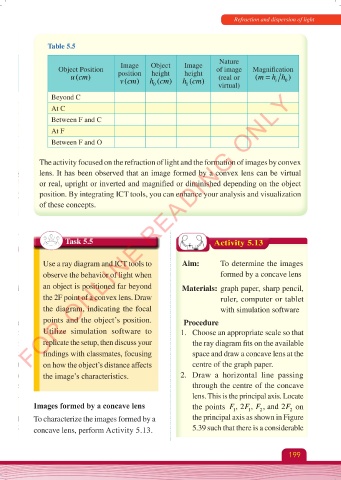
               Table 5.5

                                                                   Nature
                                      Image    Object    Image
                   Object Position                                of image   Magnification
                        ( u cm )     position  h height )  h height )  virtual)  (m =  hh 0 )
                                                                   (real or
                                          )
                                       ( v cm
                                                          (cm
                                                 (cm
                                                                                    i
                                               0
                                                         1
          FOR ONLINE READING ONLY
                 Beyond C
                 At C
                 Between F and C
                 At F
                 Between F and O
             The activity focused on the refraction of light and the formation of images by convex
             lens. It has been observed that an image formed by a convex lens can be virtual
             or real, upright or inverted and magnified or diminished depending on the object
             position. By integrating ICT tools, you can enhance your analysis and visualization
             of these concepts.


                     Task 5.5                                     Activity 5.13


              Use a ray diagram and ICT tools to        Aim:        To determine the images
              observe the behavior of light when                    formed by a concave lens
              an object is positioned far beyond        Materials: graph paper, sharp pencil,
              the 2F point of a convex lens. Draw                   ruler, computer or tablet
              the diagram, indicating the focal                     with simulation software
              points and the object’s position.          Procedure

              Utilize simulation software  to           1.  Choose an appropriate scale so that
              replicate the setup, then discuss your       the ray diagram fits on the available
              findings with classmates, focusing           space and draw a concave lens at the
              on how the object’s distance affects         centre of the graph paper.
              the image’s characteristics.              2.  Draw a horizontal line passing
                                                           through the centre of the concave
                                                           lens. This is the principal axis. Locate
           Images formed by a concave lens                 the points  F 1 , 2 ,FF 2 , and 2F on
                                                                            1
                                                                                         2
           To characterize the images formed by a          the principal axis as shown in Figure
           concave lens, perform Activity 5.13.            5.39 such that there is a considerable


                                                                                        199


     Physics Form 2 Final.indd   199                                                        25/10/2025   10:28

