


Page 207 - Physics_Form_2
P. 207
Refraction and dispersion of light
This activity demonstrates that the image 2. Thus, measuring the distance
positions for an object in front of a concave of the image, we obtain 3.3 cm
lens are located between the focal point and the on the opposite side of the lens
optical centre. For diverging lenses, the images (real image), and the height
are always erect, diminished, and virtual. By of the image is 1.4 cm and is
FOR ONLINE READING ONLY
incorporating ICT tools, you can visualise and inverted.
analyse the behaviour of light more effectively.
3. Converting using the scale we
Example 5.3 have:
An object 5 cm in length is placed at a (a) Distance of image
distance of 25 cm away from a converging 3.3 cm 5 cm 16.5 cm
lens of focal length 10 cm. Use a ray diagram 1 cm
to determine the position, size and nature of
the formed image. (b) Height of image
Solution = 1.4 cm ×5 cm = 3.5 cm
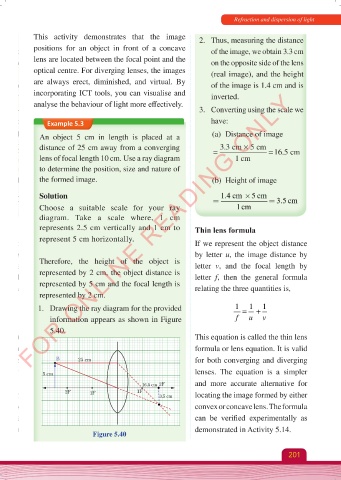
Choose a suitable scale for your ray 1 cm
diagram. Take a scale where, 1 cm
represents 2.5 cm vertically and 1 cm to Thin lens formula
represent 5 cm horizontally.
If we represent the object distance
by letter u, the image distance by
Therefore, the height of the object is letter v, and the focal length by
represented by 2 cm, the object distance is letter f, then the general formula
represented by 5 cm and the focal length is relating the three quantities is,
represented by 2 cm.
1. Drawing the ray diagram for the provided 1 = 1 + 1
information appears as shown in Figure f u v
5.40.
This equation is called the thin lens
formula or lens equation. It is valid
B 25 cm for both converging and diverging
lenses. The equation is a simpler
5 cm
16.5 cm 2F and more accurate alternative for
2F 1F 1F locating the image formed by either
3.5 cm
convex or concave lens. The formula
can be verified experimentally as
demonstrated in Activity 5.14.
Figure 5.40
201
Physics Form 2 Final.indd 201 25/10/2025 10:28

