


Page 202 - Physics_Form_2
P. 202
Physics for Secondary Schools


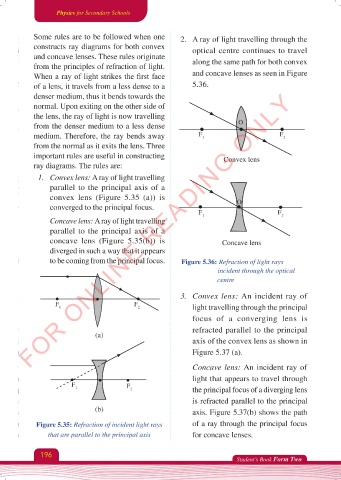
           Some rules are to be followed when one       2.  A ray of light travelling through the
           constructs ray diagrams for both convex         optical centre continues to travel
           and concave lenses. These rules originate
           from the principles of refraction of light.     along the same path for both convex
           When a ray of light strikes the first face      and concave lenses as seen in Figure
           of a lens, it travels from a less dense to a    5.36.
          FOR ONLINE READING ONLY
           denser medium, thus it bends towards the
           normal. Upon exiting on the other side of
           the lens, the ray of light is now travelling
           from the denser medium to a less dense                        O
           medium. Therefore, the ray bends away             F 1                      F 2
           from the normal as it exits the lens. Three
           important rules are useful in constructing                Convex lens
           ray diagrams. The rules are:
             1.  Convex lens: A ray of light travelling
                parallel to the principal axis of a
                convex lens (Figure 5.35 (a)) is                         O
                converged to the principal focus.
                                                             F 1                     F 2
                Concave lens: A ray of light travelling
                parallel to the principal axis of a
                concave lens (Figure 5.35(b)) is                    Concave lens
                diverged in such a way that it appears
                to be coming from the principal focus.      Figure 5.36: Refraction of light rays
                                                                              incident through the optical
                                                                       centre

                                                        3.  Convex lens: An incident ray of
                  F 1                     F 2              light travelling through the principal
                                                           focus of a converging lens is
                                                           refracted parallel to the principal
                              (a)
                                                           axis of the convex lens as shown in

                                                           Figure 5.37 (a).
                                                           Concave lens: An incident ray of
                                                           light that appears to travel through
                       F               F
                        1               2                  the principal focus of a diverging lens
                                                           is refracted parallel to the principal
                              (b)                          axis. Figure 5.37(b) shows the path

            Figure 5.35: Refraction of incident light rays   of a ray through the principal focus
                that are parallel to the principal axis    for concave lenses.


             196
                                                                         Student’s Book Form Two


     Physics Form 2 Final.indd   196                                                        25/10/2025   10:28

