


Page 206 - Physics_Form_2
P. 206
Physics for Secondary Schools


                                                           lines, extend the refracted rays on the
                distance between point 2F  and the         opposite side of the lens until they
                                         1
                optical centre, O.                         intersect. The point of intersection
             3.  Using the chosen scale, draw an           is the image point of the top of the
                upright arrow at a point just beyond       object. Note that, any two rays are
                2F . The arrow represents an object.       enough to locate the position of an
                   1
          FOR ONLINE READING ONLY
             4.  From the top of the object arrow,         object.
                draw a ray toward the focal point
                on the opposite side of the lens,       7.  Now, choose a point at the bottom
                stopping at the lens.                      of the object and repeat steps 4
             5.  Draw a second ray parallel to             to 7. This way you can locate the
                the principal axis, and a third ray        image of the bottom of the object.
                directed to the optical center of the      Use an arrow to draw the image by
                lens, marking arrowheads to indicate       joining the top and bottom points of
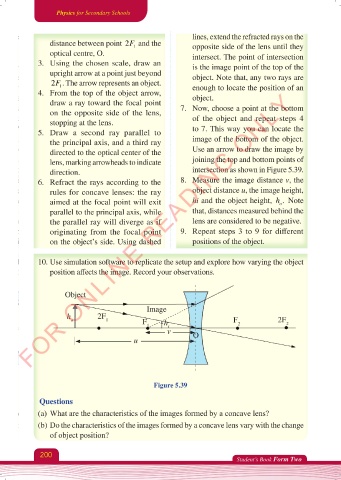
                direction.                                 intersection as shown in Figure 5.39.
             6.  Refract the rays according to the      8.  Measure the image distance v, the
                rules for concave lenses: the ray          object distance u, the image height,
                                                                                      .
                aimed at the focal point will exit         hi and the object height,  h  Note
                                                                                      o
                parallel to the principal axis, while      that, distances measured behind the
                the parallel ray will diverge as if        lens are considered to be negative.
                originating from the focal point        9.  Repeat steps 3 to 9 for different
                on the object’s side. Using dashed         positions of the object.

             10. Use simulation software to replicate the setup and explore how varying the object
                position affects the image. Record your observations.


                     Object
                                             Image
                     h        2F
                      o          1          F      h                    F            2F
                                             1      i                    2              2
                                                    v      O
                                         u


                                                Figure 5.39

             Questions
             (a) What are the characteristics of the images formed by a concave lens?
             (b) Do the characteristics of the images formed by a concave lens vary with the change
                of object position?


             200
                                                                         Student’s Book Form Two


     Physics Form 2 Final.indd   200                                                        25/10/2025   10:28

