


Page 204 - Physics_Form_2
P. 204
Physics for Secondary Schools


             7.  From the same point, draw another      9.  Measure the object distance, the
                ray that passes un-deflected through       image distance, the object size
                the optical centre. You may also           and the image size. Calculate
                choose to draw a ray through the           magnification.
                focal point and refract it according    10. Repeat steps 5 to 9 for different
          FOR ONLINE READING ONLY
                to the refraction rules.                   positions of the object.  That is,
             8.  Locate the point at which the             the object at the point  2F , object
                                                                                     1
                refracted rays intersect and draw          between 2F  and F object at F and
                                                                      1
                                                                             1
                                                                                        1
                an arrow from the principal axis           object between  F  and O.
                                                                            1
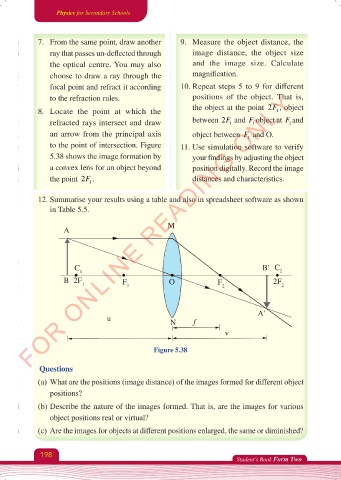
                to the point of intersection. Figure    11. Use simulation software to verify
                5.38 shows the image formation by          your findings by adjusting the object
                a convex lens for an object beyond         position digitally. Record the image
                the point 2F .                             distances and characteristics.
                            1

             12. Summarise your results using a table and also in spreadsheet software as shown
                in Table 5.5.


                                                    M
                    A


                        C 1                                                     B' C  2
                    B 2F              F             O              F                2F
                          1            1                            2                 2


                                                                               A'
                                 u
                                                     N      f
                                                                     v

                                                Figure 5.38


             Questions
             (a) What are the positions (image distance) of the images formed for different object
                positions?

             (b) Describe the nature of the images formed. That is, are the images for various
                object positions real or virtual?
             (c) Are the images for objects at different positions enlarged, the same or diminished?


             198
                                                                         Student’s Book Form Two


     Physics Form 2 Final.indd   198                                                        25/10/2025   10:28

